Transfer pricing and tax deductions upheld on established principles, while employee contributions and warranty provisions returned for fresh examinat...
Captive transfer pricing relies on industrial consumer tariffs, while genuine quotations can benchmark effluent treatment transfers under the Other Me...
Specific tariff classification for ophthalmic instruments and extended limitation principles determine the treatment of duty demands, confiscation, an...
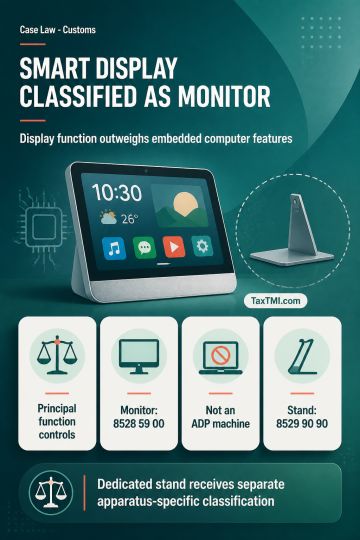
Integrated golf function determines classification, placing launch monitors and simulators under other golf equipment rather than measuring instrument...
Public servant status under anti-corruption law extends to recognised stock exchange leadership; constitutional and sanction challenges do not succeed...
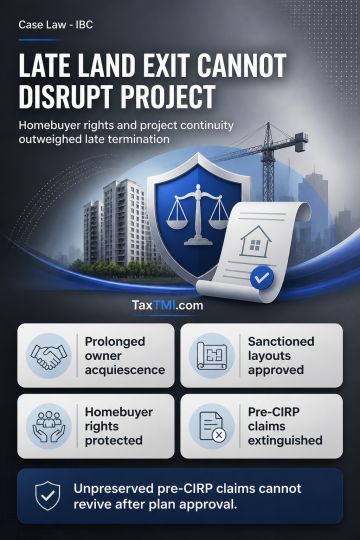
Acquiescence, homebuyer protection and clean-slate resolution principles prevent landowners from disrupting an integrated project through late termina...
Page of 4792
Press 'Enter' after typing page number.
1001 to 1020 of 95833 Results
❮
❯
❯❯
0 / 200
Expand Note
Add to Folder
No Folders have been created
+
Are you sure you want to delete "My most important" ?
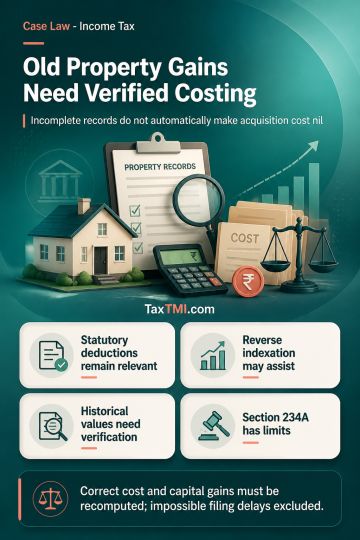
The assessment order was passed without verifying the allowability of the cost of improvement as per Section 55(1)(b)(2), rendering it erroneous and prejudicial to Revenue's interests. The assessee's claim for cost of improvement, comprising interior work, kitchen appliances, plywood flooring, and tiles, is allowable u/s 55(1)(b)(2) as the expenses were capital in nature, enhancing the property's value. The assessee submitted a valuation report and bank statements as evidence, which the AO examined and accepted. The CIT emphasized the need for a more in-depth inquiry, citing Explanation 2 to Section 263, but Section 263 cannot be invoked merely because the inquiry was not conducted as per the CIT's preference. The AO conducted adequate inquiries, and his acceptance of the cost of improvement was a plausible view. The revisionary proceedings u/s 263 were unjustified as the AO's order was neither erroneous nor prejudicial to Revenue's interests. Consequently, the revisionary order passed by the CIT u/s 263 is quashed, and the assessee's appeal is allowed.
The assessment order was passed without verifying the allowability of the cost of improvement as per Section 55(1)(b)(2), rendering it erroneous and prejudicial to Revenue's interests. The assessee's claim for cost of improvement, comprising interior work, kitchen appliances, plywood flooring, and tiles, is allowable u/s 55(1)(b)(2) as the expenses were capital in nature, enhancing the property's value. The assessee submitted a valuation report and bank statements as evidence, which the AO examined and accepted. The CIT emphasized the need for a more in-depth inquiry, citing Explanation 2 to Section 263, but Section 263 cannot be invoked merely because the inquiry was not conducted as per the CIT's preference. The AO conducted adequate inquiries, and his acceptance of the cost of improvement was a plausible view. The revisionary proceedings u/s 263 were unjustified as the AO's order was neither erroneous nor prejudicial to Revenue's interests. Consequently, the revisionary order passed by the CIT u/s 263 is quashed, and the assessee's appeal is allowed.
Note: It is a system-generated summary and is for quick reference only.
 TaxTMI
 of 4792















 Join Channel


 TaxTMI