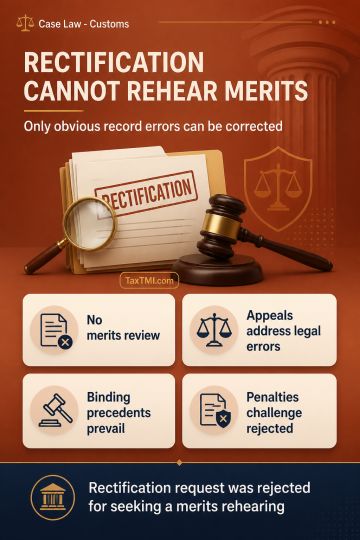
Rectification of mistake remains limited to self-evident record errors, preventing merits review through miscellaneous applications and preserving fin...
Tender creditworthiness conditions may extend to de facto Promoter Directors, with post-participation challenges generally barred absent arbitrariness...
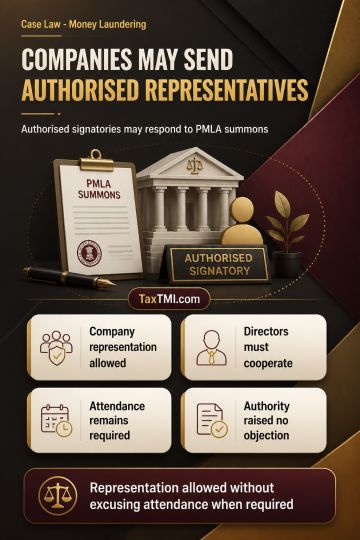
Corporate representation in PMLA summons proceedings permitted through an authorised signatory, subject to directors' continuing cooperation and atten...
Helicopter charter classification requires effective control analysis, while territorial performance, reasoned credit orders and wilful suppression de...
Specified fund definition expands PAN exemption eligibility for registered alternative investment funds and qualifying International Financial Service...
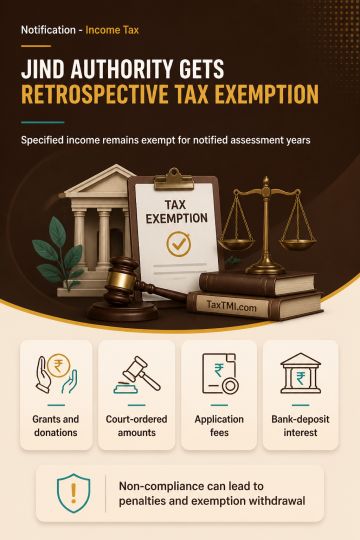
Tax exemption for specified legal-services authority income applies retrospectively, subject to non-commercial activity, unchanged income sources, and...
Page of 4784
Press 'Enter' after typing page number.
541 to 560 of 95673 Results
❮
❯
❯❯
0 / 200
Expand Note
Add to Folder
No Folders have been created
+
Are you sure you want to delete "My most important" ?
The assessment order was passed without verifying the allowability of the cost of improvement as per Section 55(1)(b)(2), rendering it erroneous and prejudicial to Revenue's interests. The assessee's claim for cost of improvement, comprising interior work, kitchen appliances, plywood flooring, and tiles, is allowable u/s 55(1)(b)(2) as the expenses were capital in nature, enhancing the property's value. The assessee submitted a valuation report and bank statements as evidence, which the AO examined and accepted. The CIT emphasized the need for a more in-depth inquiry, citing Explanation 2 to Section 263, but Section 263 cannot be invoked merely because the inquiry was not conducted as per the CIT's preference. The AO conducted adequate inquiries, and his acceptance of the cost of improvement was a plausible view. The revisionary proceedings u/s 263 were unjustified as the AO's order was neither erroneous nor prejudicial to Revenue's interests. Consequently, the revisionary order passed by the CIT u/s 263 is quashed, and the assessee's appeal is allowed.
The assessment order was passed without verifying the allowability of the cost of improvement as per Section 55(1)(b)(2), rendering it erroneous and prejudicial to Revenue's interests. The assessee's claim for cost of improvement, comprising interior work, kitchen appliances, plywood flooring, and tiles, is allowable u/s 55(1)(b)(2) as the expenses were capital in nature, enhancing the property's value. The assessee submitted a valuation report and bank statements as evidence, which the AO examined and accepted. The CIT emphasized the need for a more in-depth inquiry, citing Explanation 2 to Section 263, but Section 263 cannot be invoked merely because the inquiry was not conducted as per the CIT's preference. The AO conducted adequate inquiries, and his acceptance of the cost of improvement was a plausible view. The revisionary proceedings u/s 263 were unjustified as the AO's order was neither erroneous nor prejudicial to Revenue's interests. Consequently, the revisionary order passed by the CIT u/s 263 is quashed, and the assessee's appeal is allowed.
Note: It is a system-generated summary and is for quick reference only.
 TaxTMI
 of 4784














 Join Channel


 TaxTMI