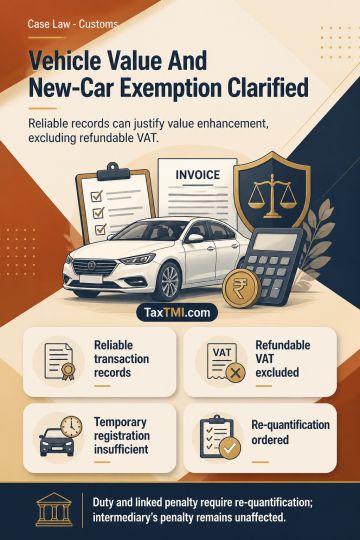
Transaction value rejection requires reliable corroboration; refundable VAT is excluded and temporary registration does not defeat new-vehicle exempti...
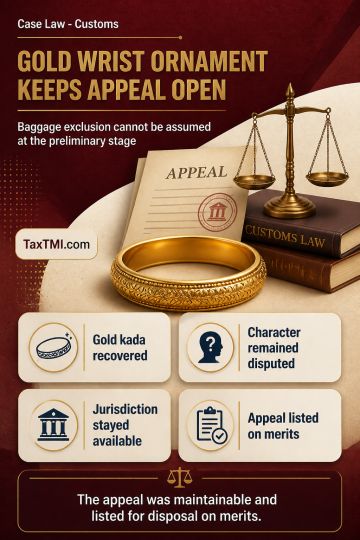
Appellate jurisdiction remains available where a wrist-worn gold ornament cannot conclusively be characterised as imported baggage at the preliminary ...
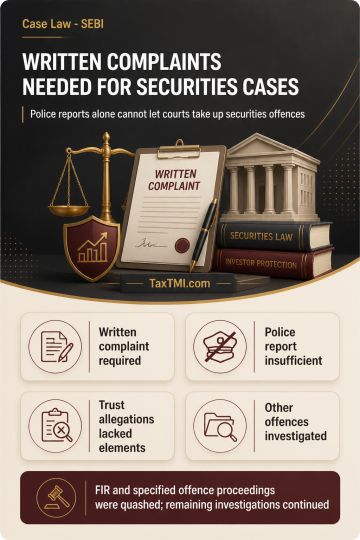
Written complaint requirement bars cognizance on police reports for securities offences, while unsupported breach of trust and cheating allegations fa...
Page of 4801
Press 'Enter' after typing page number.
341 to 360 of 96001 Results
❮
❯
❯❯
0 / 200
Expand Note
Add to Folder
No Folders have been created
+
Are you sure you want to delete "My most important" ?
Taxability of additional surcharge collected by a government-owned electricity distribution company from open access consumers who source electricity from private generators. The key points are: The company is exempt from filing certain GST returns and can claim input tax credit on capitalized goods/services and services for support/auxiliary supplies. It can also claim proportionate input tax credit on taxable output supplies of support services and goods like scrap. The company is eligible to claim taxes paid under reverse charge mechanism as input tax credit. The additional surcharge collected from open access consumers is to meet the fixed costs arising from the company's obligation to supply electricity as per power purchase agreements. This collection mechanism is backed by the Electricity Act, policies of the central and state governments, and regulations. The additional surcharge does not constitute consideration for tolerating an act but is collected to cover fixed costs incurred due to power purchase agreements. Therefore, it should form part of the taxable value u/s 15 of the CGST Act, 2017. However, the supply of electricity as goods or distribution of electricity as a service is exempt from GST under relevant notifications.
Taxability of additional surcharge collected by a government-owned electricity distribution company from open access consumers who source electricity from private generators. The key points are: The company is exempt from filing certain GST returns and can claim input tax credit on capitalized goods/services and services for support/auxiliary supplies. It can also claim proportionate input tax credit on taxable output supplies of support services and goods like scrap. The company is eligible to claim taxes paid under reverse charge mechanism as input tax credit. The additional surcharge collected from open access consumers is to meet the fixed costs arising from the company's obligation to supply electricity as per power purchase agreements. This collection mechanism is backed by the Electricity Act, policies of the central and state governments, and regulations. The additional surcharge does not constitute consideration for tolerating an act but is collected to cover fixed costs incurred due to power purchase agreements. Therefore, it should form part of the taxable value u/s 15 of the CGST Act, 2017. However, the supply of electricity as goods or distribution of electricity as a service is exempt from GST under relevant notifications.
Note: It is a system-generated summary and is for quick reference only.
 TaxTMI
 of 4801



 Join Channel


 TaxTMI