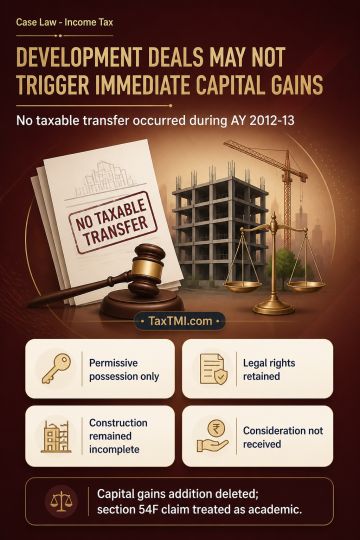
Development agreements require legal possession or effective enjoyment for capital gains transfer; permissive possession and deferred consideration de...
Prolonged sterilisation of development rights supports capital-gains treatment, while business-income disallowances cannot govern capital-gains comput...
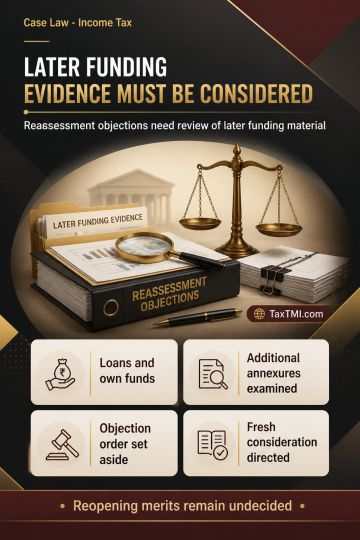
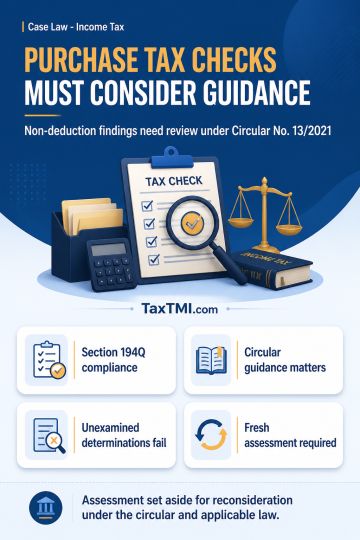
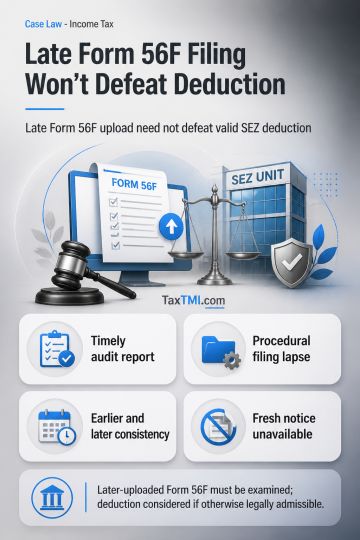
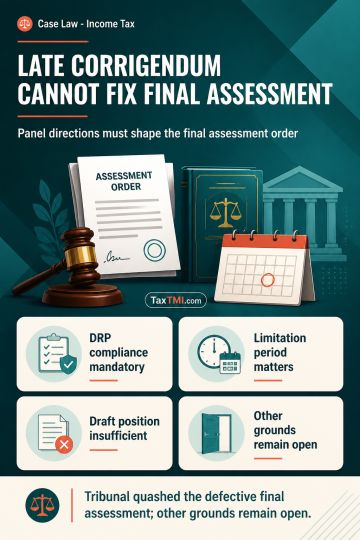
Additional evidence in transfer pricing dispute leads to fresh examination, while tax deductions, TDS credit, fee and refund interest require verifica...
Category II AIF pass-through taxation preserves non-business income character; investment receipts cannot be reclassified without applying recognised ...
The appellant imported goods declared as 'Low Aromatic White Spirit' classifiable under Customs Tariff Heading (CTH) 2710 1990, while the adjudicating authority reclassified them as 'Kerosene' under CTH 2710 1910, alleging mis-declaration. The goods were confiscated u/ss 111(m) and 111(d) of the Customs Act, 1962, for violating the Foreign Trade Policy and Petroleum Rules. The Tribunal observed that no test was conducted to determine if the goods met the requirements of 'Low Aromatic White Spirit'. It discussed the characteristics, manufacturing process, and international classification of such products under the Harmonized System Nomenclature. Based on the technical literature, the Tribunal held that the imported goods were rightly classifiable as 'Low Aromatic White Spirit' under CTH 2710 1990, not 'Kerosene'. Consequently, there was no violation of the Foreign Trade Policy or Petroleum Rules, and the goods were not liable for confiscation u/ss 111(m) and 111(d). The penalty imposed u/s 112(a)(i) was also set aside.
The appellant imported goods declared as 'Low Aromatic White Spirit' classifiable under Customs Tariff Heading (CTH) 2710 1990, while the adjudicating authority reclassified them as 'Kerosene' under CTH 2710 1910, alleging mis-declaration. The goods were confiscated u/ss 111(m) and 111(d) of the Customs Act, 1962, for violating the Foreign Trade Policy and Petroleum Rules. The Tribunal observed that no test was conducted to determine if the goods met the requirements of 'Low Aromatic White Spirit'. It discussed the characteristics, manufacturing process, and international classification of such products under the Harmonized System Nomenclature. Based on the technical literature, the Tribunal held that the imported goods were rightly classifiable as 'Low Aromatic White Spirit' under CTH 2710 1990, not 'Kerosene'. Consequently, there was no violation of the Foreign Trade Policy or Petroleum Rules, and the goods were not liable for confiscation u/ss 111(m) and 111(d). The penalty imposed u/s 112(a)(i) was also set aside.
Note: It is a system-generated summary and is for quick reference only.
 TaxTMI
 of 4805















 Join Channel


 TaxTMI
