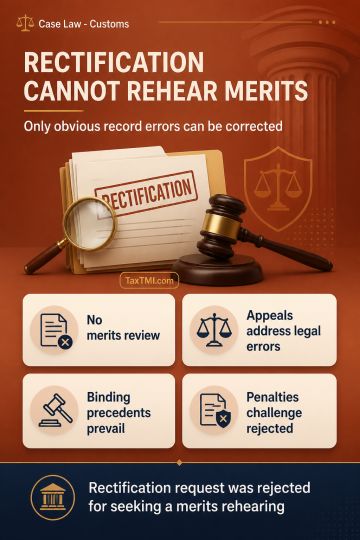
Rectification of mistake remains limited to self-evident record errors, preventing merits review through miscellaneous applications and preserving fin...
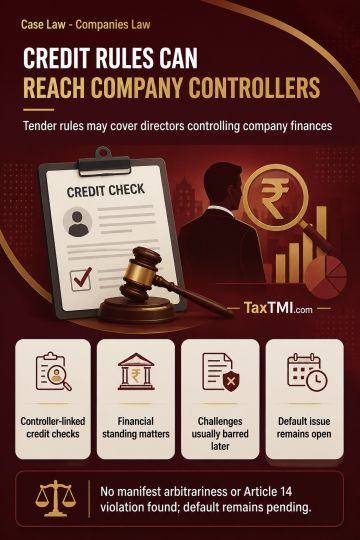
Tender creditworthiness conditions may extend to de facto Promoter Directors, with post-participation challenges generally barred absent arbitrariness...
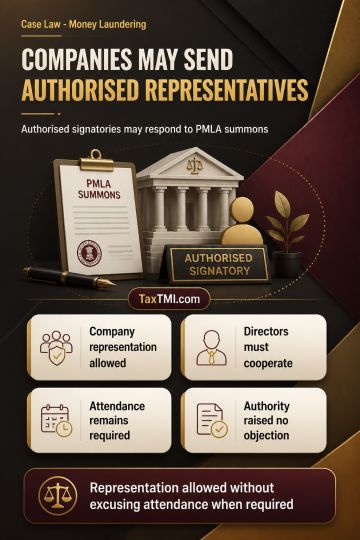
Corporate representation in PMLA summons proceedings permitted through an authorised signatory, subject to directors' continuing cooperation and atten...
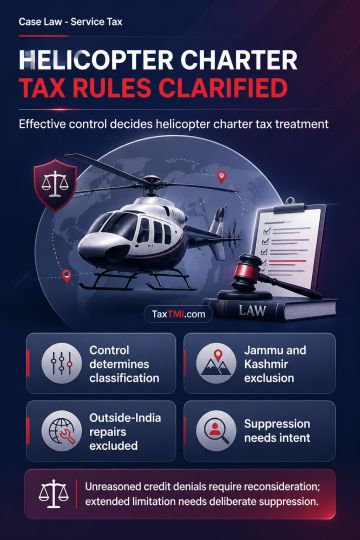
Helicopter charter classification requires effective control analysis, while territorial performance, reasoned credit orders and wilful suppression de...
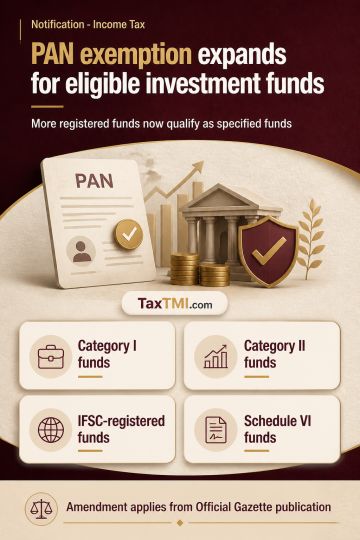
Specified fund definition expands PAN exemption eligibility for registered alternative investment funds and qualifying International Financial Service...
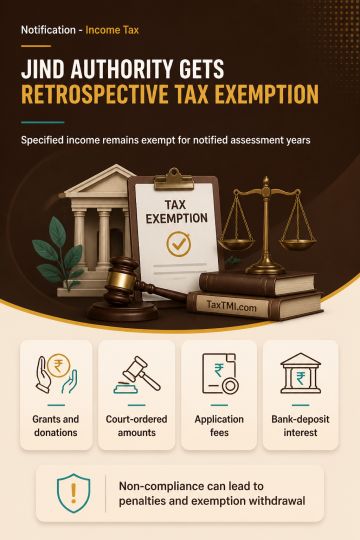
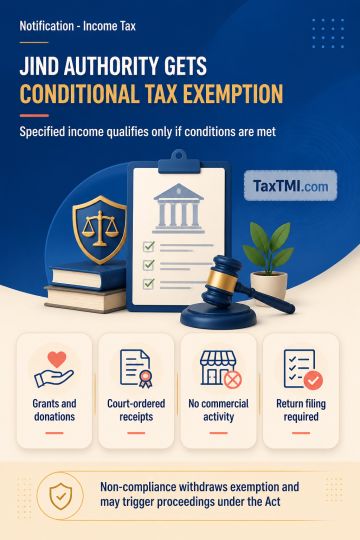
Tax exemption for specified legal-services authority income applies retrospectively, subject to non-commercial activity, unchanged income sources, and...
Page of 4792
Press 'Enter' after typing page number.
701 to 720 of 95833 Results
❮
❯
❯❯
0 / 200
Expand Note
Add to Folder
No Folders have been created
+
Are you sure you want to delete "My most important" ?
The assessee, a non-resident company incorporated in Singapore without a permanent establishment in India, received income from licensing of software to M/s. L&T Ltd. for the Vizag Smart City project. The End User License Agreement (EULA) clearly stated that no title or ownership of the software or its documentation was transferred to the buyer, and the ownership and modification rights remained with the assessee. Based on the facts and circumstances, the supply of software by the assessee to M/s. L&T Ltd. cannot be treated as royalty u/s 9(1)(vi) of the Income Tax Act or Article 12 of the India-Singapore DTAA. The decision relies on the Supreme Court's ruling in Engineering Analysis and Centre of Excellence Pvt. Ltd., as well as the Delhi High Court's judgments in CIT vs. Microsoft Corporation and EY Global Services Ltd., which held that mere supply of software without a sale of copyright cannot be treated as royalty for taxation purposes u/s 9(1)(vi). Following these precedents, the ITAT set aside the Assessing Officer's order, concluding that the supply of software by the assessee cannot be brought to tax under the Income Tax Act or the India-Singapore DTAA.
The assessee, a non-resident company incorporated in Singapore without a permanent establishment in India, received income from licensing of software to M/s. L&T Ltd. for the Vizag Smart City project. The End User License Agreement (EULA) clearly stated that no title or ownership of the software or its documentation was transferred to the buyer, and the ownership and modification rights remained with the assessee. Based on the facts and circumstances, the supply of software by the assessee to M/s. L&T Ltd. cannot be treated as royalty u/s 9(1)(vi) of the Income Tax Act or Article 12 of the India-Singapore DTAA. The decision relies on the Supreme Court's ruling in Engineering Analysis and Centre of Excellence Pvt. Ltd., as well as the Delhi High Court's judgments in CIT vs. Microsoft Corporation and EY Global Services Ltd., which held that mere supply of software without a sale of copyright cannot be treated as royalty for taxation purposes u/s 9(1)(vi). Following these precedents, the ITAT set aside the Assessing Officer's order, concluding that the supply of software by the assessee cannot be brought to tax under the Income Tax Act or the India-Singapore DTAA.
Note: It is a system-generated summary and is for quick reference only.
 TaxTMI
 of 4792




 Join Channel


 TaxTMI