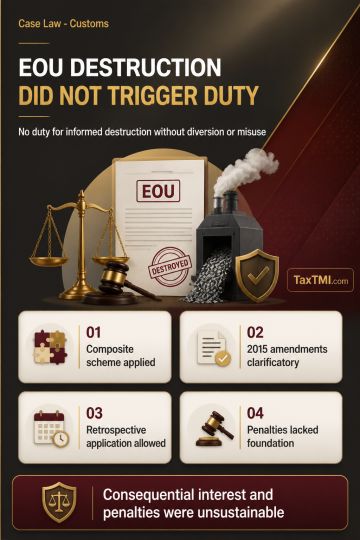
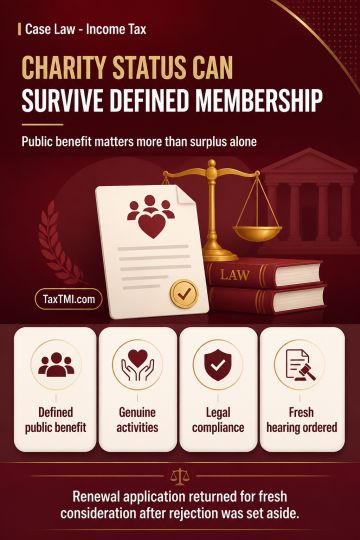
Defined public benefit can retain charitable character; registration renewal requires examining genuine activities and legal compliance, not surplus a...
Capital reduction is distinct from share buy-back, preventing buy-back tax; restructuring interest and related business deductions also survive scruti...
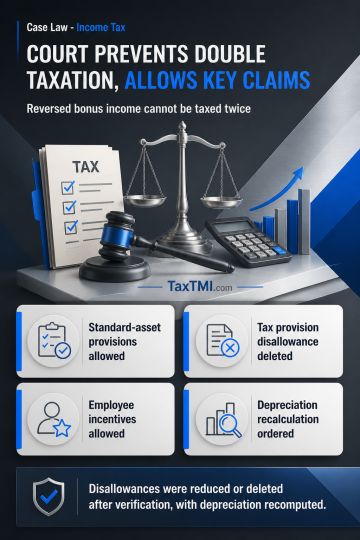
Transfer pricing and tax deductions upheld on established principles, while employee contributions and warranty provisions returned for fresh examinat...
Captive transfer pricing relies on industrial consumer tariffs, while genuine quotations can benchmark effluent treatment transfers under the Other Me...
Specific tariff classification for ophthalmic instruments and extended limitation principles determine the treatment of duty demands, confiscation, an...
The appellant imported ELISA Test Kits for food testing but classified them under 3822 00 90 as diagnostic kits to claim exemption under customs notifications. The Tribunal held that ELISA kits for food testing cannot be treated as diagnostic kits eligible for exemption. Explanatory notes clarify that diagnostic reagents covered under 3822 are for evaluating processes in humans/animals, not for food testing. The exemption notification must be construed strictly, and its intent is to cover medical products. Appellant failed to prove the imported kits fell within the exemption parameters. The term "food testing" cannot be implied or added to "diagnostic kits" in the notification. Therefore, the imported ELISA kits for food testing did not qualify for exemption as diagnostic reagents/kits.
The appellant imported ELISA Test Kits for food testing but classified them under 3822 00 90 as diagnostic kits to claim exemption under customs notifications. The Tribunal held that ELISA kits for food testing cannot be treated as diagnostic kits eligible for exemption. Explanatory notes clarify that diagnostic reagents covered under 3822 are for evaluating processes in humans/animals, not for food testing. The exemption notification must be construed strictly, and its intent is to cover medical products. Appellant failed to prove the imported kits fell within the exemption parameters. The term "food testing" cannot be implied or added to "diagnostic kits" in the notification. Therefore, the imported ELISA kits for food testing did not qualify for exemption as diagnostic reagents/kits.
Note: It is a system-generated summary and is for quick reference only.
 TaxTMI
 of 4805










 Join Channel


 TaxTMI