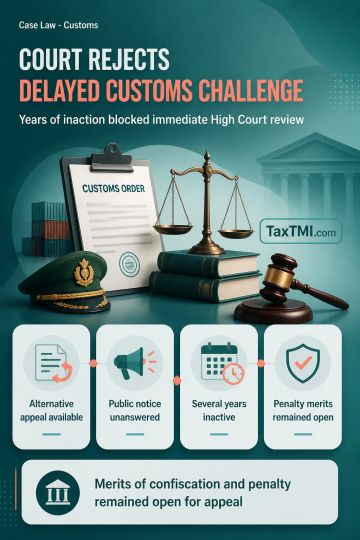
Alternative statutory remedy and unexplained delay barred writ review of customs confiscation adjudication, leaving merits for appellate consideration...
Authorised courier due diligence protects against penalties where declared exports conceal prohibited goods despite proper documentation and customs p...
Customs-controlled container movement now extends to DP World facilities, subject to segregation, inspections, reconciliation, and EXIM cargo priority...
Classification of a security deposit made by the appellant for a lease deed with the corporate debtor, as either a financial debt or an operational debt under the Insolvency and Bankruptcy Code (IBC). The key points are: The security deposit is a claim within the meaning of the IBC. To qualify as a financial debt u/s 5(8), there must be a disbursal of money against consideration for the time value of money. However, the security deposit was a refundable corpus amount without interest, not disbursed for time value of money, lacking elements of commercial borrowing. Therefore, it does not satisfy the definition of financial debt. An operational debt u/s 5(21) relates to claims for provision of goods, services, employment, or government dues. The security deposit, being an advance for prospective occupation and use of leased premises, can be considered a claim for services, satisfying the definition of operational debt. The NCLAT held that the security deposit should be classified as an operational debt, and the appellant should be accorded the status of an operational creditor. The resolution professional was directed to admit the appellant's claim as an operational creditor and allow the appellant to substitute the relevant form.
Classification of a security deposit made by the appellant for a lease deed with the corporate debtor, as either a financial debt or an operational debt under the Insolvency and Bankruptcy Code (IBC). The key points are: The security deposit is a claim within the meaning of the IBC. To qualify as a financial debt u/s 5(8), there must be a disbursal of money against consideration for the time value of money. However, the security deposit was a refundable corpus amount without interest, not disbursed for time value of money, lacking elements of commercial borrowing. Therefore, it does not satisfy the definition of financial debt. An operational debt u/s 5(21) relates to claims for provision of goods, services, employment, or government dues. The security deposit, being an advance for prospective occupation and use of leased premises, can be considered a claim for services, satisfying the definition of operational debt. The NCLAT held that the security deposit should be classified as an operational debt, and the appellant should be accorded the status of an operational creditor. The resolution professional was directed to admit the appellant's claim as an operational creditor and allow the appellant to substitute the relevant form.
Note: It is a system-generated summary and is for quick reference only.
 TaxTMI
  TaxTMI
 of 4828












 Join Channel


