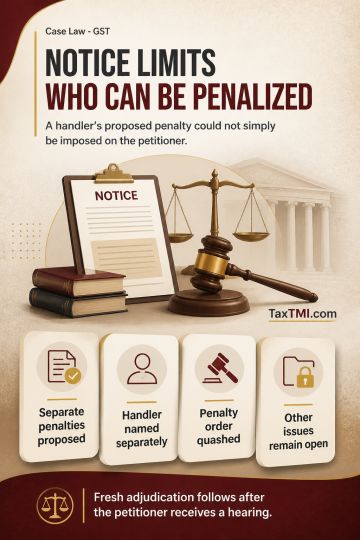
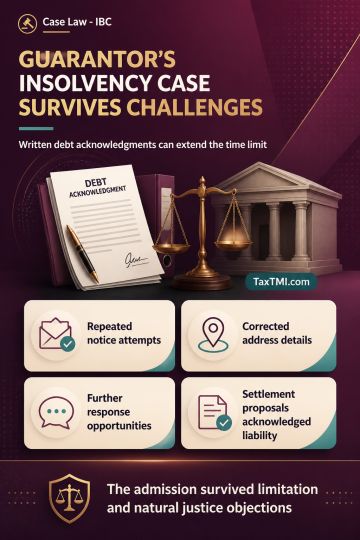
Service of notice and contractual debt acknowledgment preserved insolvency admission against a corporate guarantor despite limitation and natural just...
Original works exemption excludes standalone boulder transportation, leaving subcontracted railway-project transport services subject to service tax l...
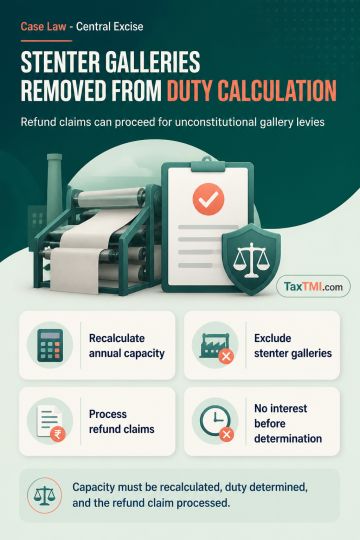
Annual production capacity determinations excluding stenter galleries support refunds for unconstitutional excise levies without an unjust-enrichment ...
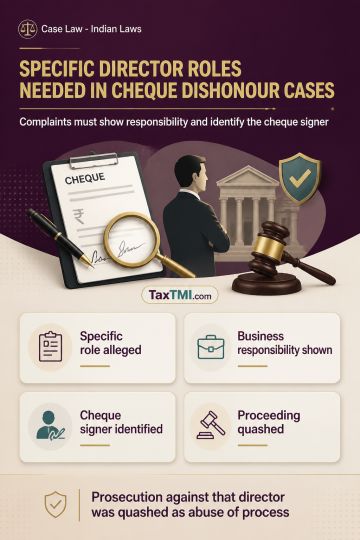
Vicarious liability for cheque dishonour requires specific allegations of responsibility and cheque signatory; generic director allegations cannot sus...
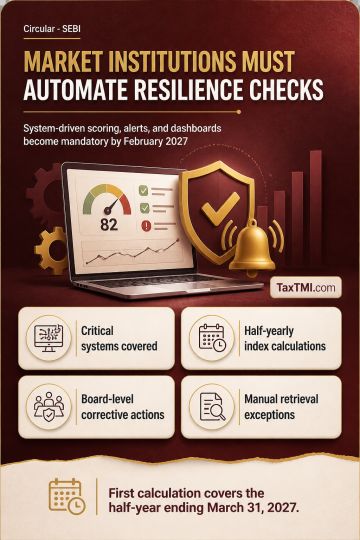
IT Resilience Index requires market infrastructure institutions to automate resilience scoring, early warnings, and continuous service-delivery monito...
The Supreme Court examined a challenge u/s 34 of the Arbitration and Conciliation Act, 1996 against an arbitral award and the grant of conditional stay on its execution. The High Court had directed the respondent, a statutory undertaking, to furnish a bank guarantee only for the principal amount awarded, excluding interest and costs, reasoning that the respondent was not a "fly-by operator." The Supreme Court held that the Arbitration Act does not distinguish between governmental and private entities, and the High Court erred in basing its decision on the respondent's status as a statutory authority. The Court modified the High Court's order, directing the respondent to deposit 75% of the decretal amount, inclusive of interest, by a specified date, conditional upon which the enforcement of the arbitral award would be stayed. The Court emphasized that the principles governing arbitration proceedings cannot vary based on the parties' status.
The Supreme Court examined a challenge u/s 34 of the Arbitration and Conciliation Act, 1996 against an arbitral award and the grant of conditional stay on its execution. The High Court had directed the respondent, a statutory undertaking, to furnish a bank guarantee only for the principal amount awarded, excluding interest and costs, reasoning that the respondent was not a "fly-by operator." The Supreme Court held that the Arbitration Act does not distinguish between governmental and private entities, and the High Court erred in basing its decision on the respondent's status as a statutory authority. The Court modified the High Court's order, directing the respondent to deposit 75% of the decretal amount, inclusive of interest, by a specified date, conditional upon which the enforcement of the arbitral award would be stayed. The Court emphasized that the principles governing arbitration proceedings cannot vary based on the parties' status.
Note: It is a system-generated summary and is for quick reference only.
 TaxTMI
  TaxTMI
 of 4828












 Join Channel