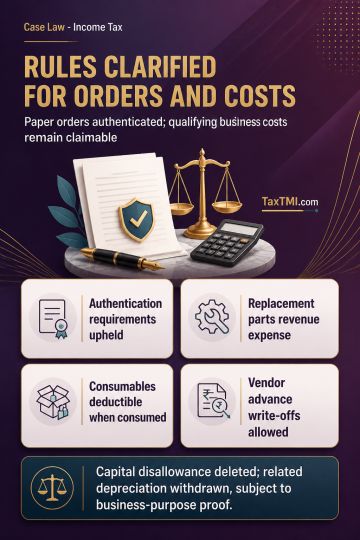
Authentication of paper assessment orders upheld, while qualifying repairs, consumables and vendor advance write-offs remain deductible business claim...
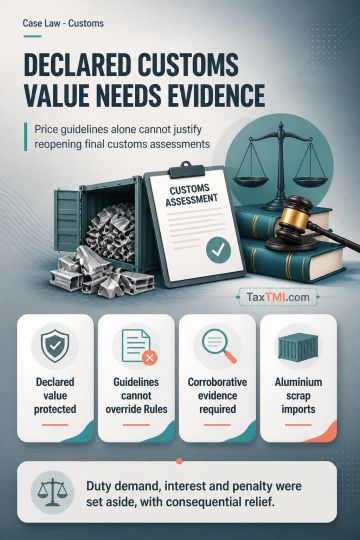
Transaction value cannot be rejected solely on non-statutory valuation guidelines without corroborative evidence supporting reassessment of final cust...
Cross-examination rights and corroborated evidence limit customs penalties for misdeclaration in genuine import transactions involving documented clea...
Tariff classification of vehicle gear components follows the specific gearing entry, displacing motor-vehicle parts classification and related liabili...
Page of 4798
Press 'Enter' after typing page number.
621 to 640 of 95955 Results
❮
❯
❯❯
0 / 200
Expand Note
Add to Folder
No Folders have been created
+
Are you sure you want to delete "My most important" ?
Validity of a complaint filed u/s 138 of the Negotiable Instruments Act through a Power of Attorney. The court held that it can quash complaints at the pre-trial stage u/s 482 of CrPC if unimpeachable material indicates the accused was not involved or no offense is made out. However, following the Supreme Court's ruling in Rathish Babu Unnikrishnan v. State, the court must examine whether the factual defense disproves the entire allegations. The complaint mentioned the authorized representative had personal knowledge and competence to file the case. While the petitioner raised questions about the attorney's capability, the extent of knowledge, and the validity of the compromise deed, these issues did not disprove the allegations and can be determined during trial after evidence is led. The court dismissed the petition, finding that the petitioner raised questions of fact and law better left for adjudication at the trial stage.
Validity of a complaint filed u/s 138 of the Negotiable Instruments Act through a Power of Attorney. The court held that it can quash complaints at the pre-trial stage u/s 482 of CrPC if unimpeachable material indicates the accused was not involved or no offense is made out. However, following the Supreme Court's ruling in Rathish Babu Unnikrishnan v. State, the court must examine whether the factual defense disproves the entire allegations. The complaint mentioned the authorized representative had personal knowledge and competence to file the case. While the petitioner raised questions about the attorney's capability, the extent of knowledge, and the validity of the compromise deed, these issues did not disprove the allegations and can be determined during trial after evidence is led. The court dismissed the petition, finding that the petitioner raised questions of fact and law better left for adjudication at the trial stage.
Note: It is a system-generated summary and is for quick reference only.
 TaxTMI
 of 4798











 Join Channel


 TaxTMI

