Defined public benefit can retain charitable character; registration renewal requires examining genuine activities and legal compliance, not surplus a...
Capital reduction is distinct from share buy-back, preventing buy-back tax; restructuring interest and related business deductions also survive scruti...
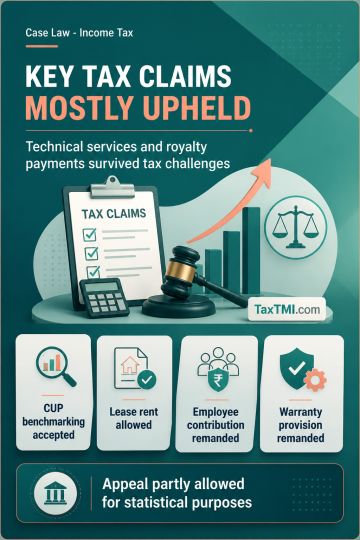
Transfer pricing and tax deductions upheld on established principles, while employee contributions and warranty provisions returned for fresh examinat...
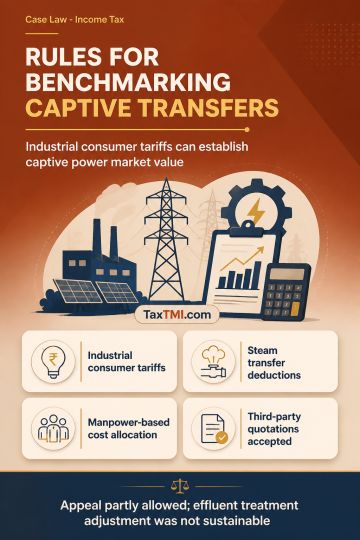
Captive transfer pricing relies on industrial consumer tariffs, while genuine quotations can benchmark effluent treatment transfers under the Other Me...
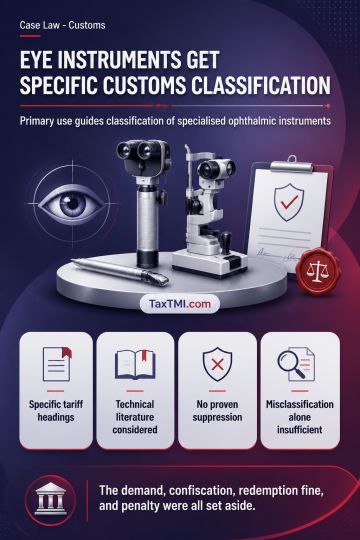
Specific tariff classification for ophthalmic instruments and extended limitation principles determine the treatment of duty demands, confiscation, an...
Integrated golf function determines classification, placing launch monitors and simulators under other golf equipment rather than measuring instrument...
Levy of penalties u/ss 122 and 129 of CGST/SGST Acts - expiry of e-way bill - mens rea in penalty imposition. Technically, violation of law by petitioner in transporting goods without revalidating e-way bill. However, once plausible explanation provided by transporter/assessee and no attempt to evade tax found, proceedings should not culminate in maximum penalty u/s 129. Officer should have imposed penalty u/s 122(1)(xiv) only. Provisions of Section 129 do not authorize imposition of tax/penalty u/s 129(1)(a) or 129(1)(b) in cases of minor discrepancies; such penalty can be imposed only for violations leading to tax evasion, intent to evade tax, or repeated violations. In other cases, penalties u/ss 122 and 126 to be imposed. In present case, penalty of Rs. 10,000/- u/s 122(1)(xiv) can be imposed. On payment of penalty, bank guarantee to be released.
Levy of penalties u/ss 122 and 129 of CGST/SGST Acts - expiry of e-way bill - mens rea in penalty imposition. Technically, violation of law by petitioner in transporting goods without revalidating e-way bill. However, once plausible explanation provided by transporter/assessee and no attempt to evade tax found, proceedings should not culminate in maximum penalty u/s 129. Officer should have imposed penalty u/s 122(1)(xiv) only. Provisions of Section 129 do not authorize imposition of tax/penalty u/s 129(1)(a) or 129(1)(b) in cases of minor discrepancies; such penalty can be imposed only for violations leading to tax evasion, intent to evade tax, or repeated violations. In other cases, penalties u/ss 122 and 126 to be imposed. In present case, penalty of Rs. 10,000/- u/s 122(1)(xiv) can be imposed. On payment of penalty, bank guarantee to be released.
Note: It is a system-generated summary and is for quick reference only.
 TaxTMI
 of 4807











 Join Channel


 TaxTMI
