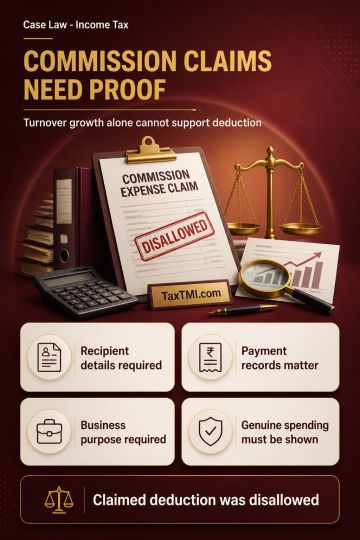
Business expenditure deduction requires proof of genuine commission payments and commercial allowability; turnover growth alone cannot validate the cl...
Article 8 treaty coverage excluded third-party airline support services, while documented demonetisation cash receipts remained accepted business inco...
Functional comparability under TNMM requires highway contract benchmarks to reflect operation, maintenance and transfer activities, requiring fresh be...
Objective characteristics govern magnesium bis-glycinate chelate classification as an amino-acid coordination compound, not a food preparation or anti...
Page of 4803
Press 'Enter' after typing page number.
581 to 600 of 96046 Results
❮
❯
❯❯
0 / 200
Expand Note
Add to Folder
No Folders have been created
+
Are you sure you want to delete "My most important" ?
This is a summary of a legal case related to the dishonor of a cheque. The court held that the accused failed to rebut the presumption of consideration for the cheque by providing satisfactory evidence. The accused did not dispute taking the loan, issuing the cheque, or their signature on the cheque. The burden shifted to the accused to rebut the presumption that the cheque was issued in discharge of a legal liability, which they failed to do. The accused also failed to pay the amount within 15 days of receiving the court summons, precluding them from claiming non-receipt of notice. The court upheld the trial court's sentence, including a fine of twice the cheque amount along with 9% simple interest per annum as compensation, as it was not excessive given the legal expenses and loss of interest incurred by the complainant over the three-year period.
This is a summary of a legal case related to the dishonor of a cheque. The court held that the accused failed to rebut the presumption of consideration for the cheque by providing satisfactory evidence. The accused did not dispute taking the loan, issuing the cheque, or their signature on the cheque. The burden shifted to the accused to rebut the presumption that the cheque was issued in discharge of a legal liability, which they failed to do. The accused also failed to pay the amount within 15 days of receiving the court summons, precluding them from claiming non-receipt of notice. The court upheld the trial court's sentence, including a fine of twice the cheque amount along with 9% simple interest per annum as compensation, as it was not excessive given the legal expenses and loss of interest incurred by the complainant over the three-year period.
Note: It is a system-generated summary and is for quick reference only.
 TaxTMI
 of 4803










 Join Channel


 TaxTMI