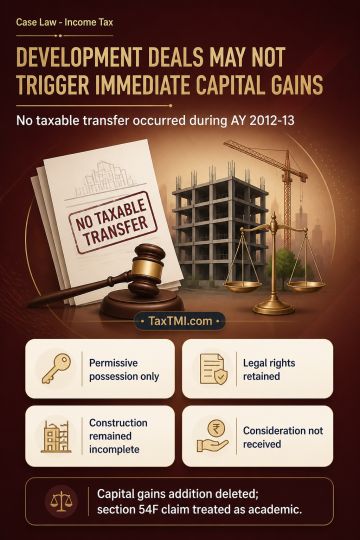
Development agreements require legal possession or effective enjoyment for capital gains transfer; permissive possession and deferred consideration de...
Prolonged sterilisation of development rights supports capital-gains treatment, while business-income disallowances cannot govern capital-gains comput...
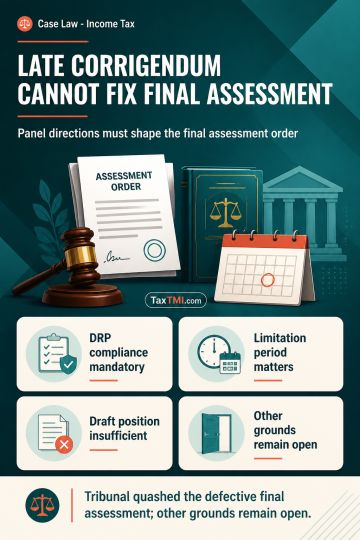
Additional evidence in transfer pricing dispute leads to fresh examination, while tax deductions, TDS credit, fee and refund interest require verifica...
Category II AIF pass-through taxation preserves non-business income character; investment receipts cannot be reclassified without applying recognised ...
Mutual fund maturity rules require proper rollover, redemption, disclosure, and due diligence; investor gains cannot excuse regulatory breaches or pen...
The Court rejected the petitioner's challenge to the show cause notice (SCN) issued u/s 74 of the CGST Act on jurisdictional grounds. The petitioner failed to submit a reply to the SCN, which emanated from a GST audit report after examining records for specific periods. The objection regarding the officer's lack of jurisdiction over the petitioner's business in other States was misconceived. The Court held that officers appointed u/ss 4, 5, and 6 of the CGST Act have the same powers, and a State GST Officer is authorized as a proper officer under the Act. Once an SCN is issued by a State GST Officer, no other officer from another State can initiate proceedings regarding tax evasion, wrongful input tax credit, or other issues u/s 74. The Chandigarh authority had the power to issue the SCN concerning the company's dealings in other States, and there was no jurisdictional error. The petitioner is free to raise objections and arguments in its reply to the SCN's contents. The petition was dismissed.
The Court rejected the petitioner's challenge to the show cause notice (SCN) issued u/s 74 of the CGST Act on jurisdictional grounds. The petitioner failed to submit a reply to the SCN, which emanated from a GST audit report after examining records for specific periods. The objection regarding the officer's lack of jurisdiction over the petitioner's business in other States was misconceived. The Court held that officers appointed u/ss 4, 5, and 6 of the CGST Act have the same powers, and a State GST Officer is authorized as a proper officer under the Act. Once an SCN is issued by a State GST Officer, no other officer from another State can initiate proceedings regarding tax evasion, wrongful input tax credit, or other issues u/s 74. The Chandigarh authority had the power to issue the SCN concerning the company's dealings in other States, and there was no jurisdictional error. The petitioner is free to raise objections and arguments in its reply to the SCN's contents. The petition was dismissed.
Note: It is a system-generated summary and is for quick reference only.
 TaxTMI
 of 4807


















 Join Channel


 TaxTMI

