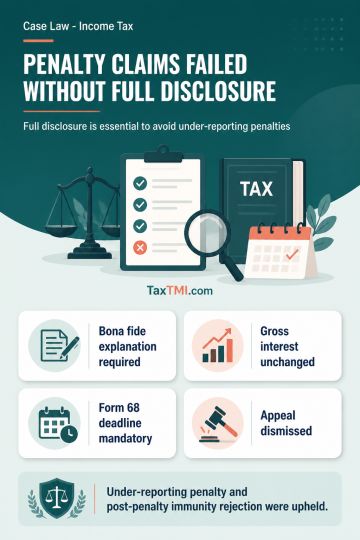
Bona fide disclosure requirements govern under-reporting penalties, and post-penalty immunity applications cannot secure available statutory protectio...
Certificate-of-origin verification procedure governs preferential customs benefits; denial without retroactive verification was set aside with consequ...
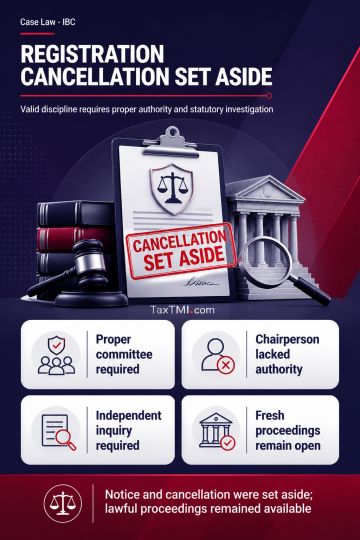
Disciplinary Committee jurisdiction and mandatory investigation requirements invalidated cancellation of an insolvency professional's registration and...
The imposition of a time limit for availing Input Tax Credit (ITC) is violative of Articles 14, 19(1)(g), and 300A of the Constitution of India. The insertion of sub-section (5) u/s 16 of the CGST Act, effective from July 1, 2017, provided that for invoices or debit notes pertaining to Financial Years 2017-18 to 2020-21, the registered person could take ITC in any return filed until November 30, 2021. However, this decision was taken without considering the stipulation in sub-section (5) of Section 16, effective from July 1, 2017. Consequently, the High Court remitted the matter to the authority to pass a fresh order considering the implication of sub-section (5) of Section 16 of the CGST Act.
The imposition of a time limit for availing Input Tax Credit (ITC) is violative of Articles 14, 19(1)(g), and 300A of the Constitution of India. The insertion of sub-section (5) u/s 16 of the CGST Act, effective from July 1, 2017, provided that for invoices or debit notes pertaining to Financial Years 2017-18 to 2020-21, the registered person could take ITC in any return filed until November 30, 2021. However, this decision was taken without considering the stipulation in sub-section (5) of Section 16, effective from July 1, 2017. Consequently, the High Court remitted the matter to the authority to pass a fresh order considering the implication of sub-section (5) of Section 16 of the CGST Act.
Note: It is a system-generated summary and is for quick reference only.
 TaxTMI
 of 4805









 Join Channel


 TaxTMI
