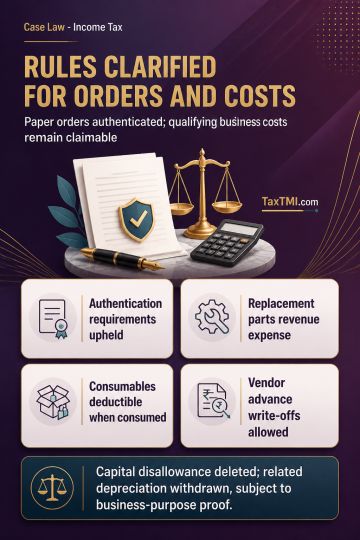
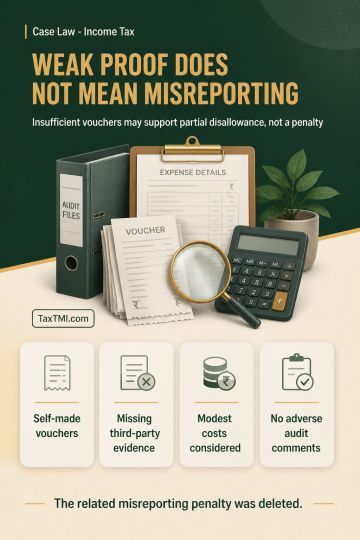
Authentication of paper assessment orders upheld, while qualifying repairs, consumables and vendor advance write-offs remain deductible business claim...
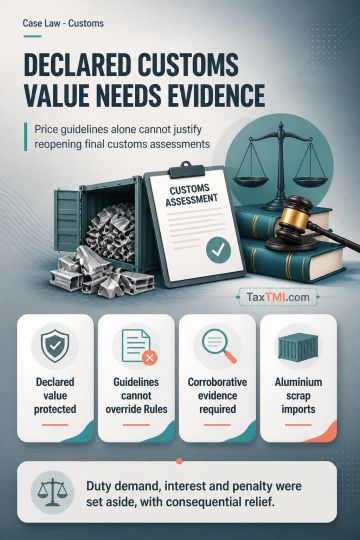
Transaction value cannot be rejected solely on non-statutory valuation guidelines without corroborative evidence supporting reassessment of final cust...
Cross-examination rights and corroborated evidence limit customs penalties for misdeclaration in genuine import transactions involving documented clea...
Tariff classification of vehicle gear components follows the specific gearing entry, displacing motor-vehicle parts classification and related liabili...
Page of 4786
Press 'Enter' after typing page number.
381 to 400 of 95715 Results
❮
❯
❯❯
0 / 200
Expand Note
Add to Folder
No Folders have been created
+
Are you sure you want to delete "My most important" ?
Insolvency and BankruptcyAugust 27, 2024Case LawsHC
Challenge to an interim arbitral award u/s 31(6) of the Arbitration and Conciliation Act, 1996. The key issues are: (1) whether the rejection of an application u/s 16 regarding the arbitrator's jurisdiction operates as res judicata for the interim award, and (2) whether alleged future losses covered by a counterclaim could be dismissed due to the approval of a Resolution Plan under the Insolvency and Bankruptcy Code (IBC). The court held that the earlier rejection u/s 16 did not operate as res judicata, as the subsequent approval of the Resolution Plan extinguishing creditors' rights altered the scenario, providing a fresh cause of action. Regarding the second issue, the court ruled that all claims, including future losses, stood extinguished upon approval of the Resolution Plan, as per Section 31 of the IBC and the Supreme Court's decision in Ghanashyam Mishra. Consequently, the arbitrator was justified in dismissing the counterclaims at the outset due to the Resolution Plan's approval. The court found no grounds to interfere with the interim award u/s 34, as the arbitrator's findings were legally correct. The petition was dismissed.
Challenge to an interim arbitral award u/s 31(6) of the Arbitration and Conciliation Act, 1996. The key issues are: (1) whether the rejection of an application u/s 16 regarding the arbitrator's jurisdiction operates as res judicata for the interim award, and (2) whether alleged future losses covered by a counterclaim could be dismissed due to the approval of a Resolution Plan under the Insolvency and Bankruptcy Code (IBC). The court held that the earlier rejection u/s 16 did not operate as res judicata, as the subsequent approval of the Resolution Plan extinguishing creditors' rights altered the scenario, providing a fresh cause of action. Regarding the second issue, the court ruled that all claims, including future losses, stood extinguished upon approval of the Resolution Plan, as per Section 31 of the IBC and the Supreme Court's decision in Ghanashyam Mishra. Consequently, the arbitrator was justified in dismissing the counterclaims at the outset due to the Resolution Plan's approval. The court found no grounds to interfere with the interim award u/s 34, as the arbitrator's findings were legally correct. The petition was dismissed.
Note: It is a system-generated summary and is for quick reference only.
 TaxTMI
 of 4786











 Join Channel


 TaxTMI

