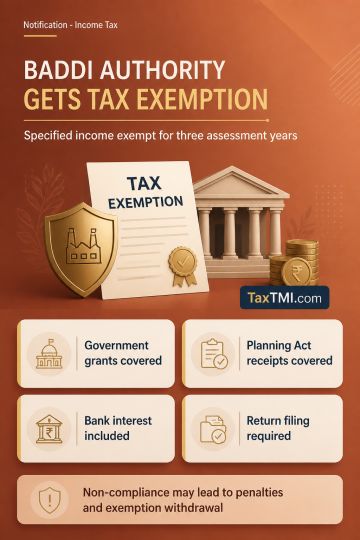
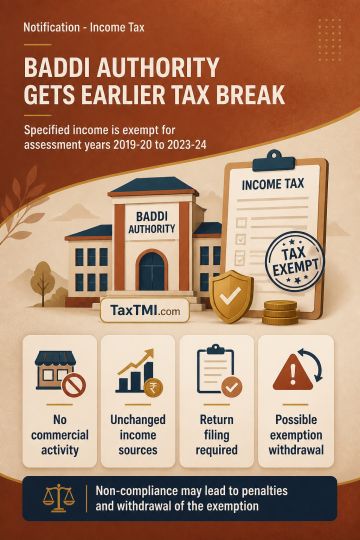
Specified income of Baddi Barotiwala Nalagarh Development Authority receives conditional tax exemption, retrospectively covering its designated assess...
Specified development authority income receives retrospective tax exemption, subject to non-commercial activity, unchanged income sources, and return-...
Unified Brand India framework introduces voluntary Trust Mark certification and funding support for export branding, packaging and global promotional ...
Origin Declaration authentication governs preferential tariff claims under India-UK CETA, requiring a validated reference number before import clearan...
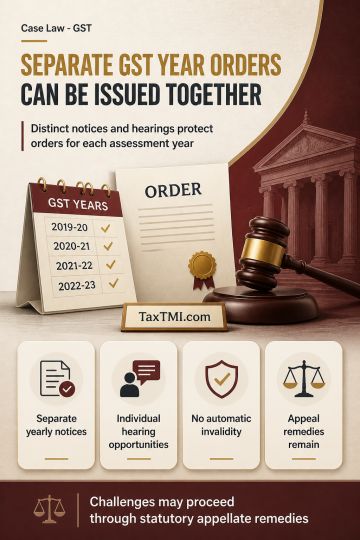
Separate assessment orders for different years remain valid when distinct notices and hearing opportunities prevent prejudice from combined proceeding...
The Income Tax Appellate Tribunal (ITAT) examined the taxability of income from a discretionary trust u/s 164(1) read with clause (ii) of Explanation 1 to Section 164 of the Income Tax Act, 1961. The key points are: Since the trustees have absolute discretion to apply the trust's income and corpus, and the beneficiaries' shares are not determined, the trust is considered a discretionary trust. The income is taxable at the maximum marginal rate as if it were the total income of an association of persons (AOP). However, the beneficiaries, being individuals, cannot be denied deductions u/ss 80C and 80TTA due to the deeming fiction of AOP. The Assessing Officer must consider allowing credit for TDS and deduction u/s 80C after verification. The ITAT emphasized that the correct income must be taxed strictly per the Act, regardless of any deficiencies in the prescribed ITR forms. The assessee's appeal was partly allowed.
The Income Tax Appellate Tribunal (ITAT) examined the taxability of income from a discretionary trust u/s 164(1) read with clause (ii) of Explanation 1 to Section 164 of the Income Tax Act, 1961. The key points are: Since the trustees have absolute discretion to apply the trust's income and corpus, and the beneficiaries' shares are not determined, the trust is considered a discretionary trust. The income is taxable at the maximum marginal rate as if it were the total income of an association of persons (AOP). However, the beneficiaries, being individuals, cannot be denied deductions u/ss 80C and 80TTA due to the deeming fiction of AOP. The Assessing Officer must consider allowing credit for TDS and deduction u/s 80C after verification. The ITAT emphasized that the correct income must be taxed strictly per the Act, regardless of any deficiencies in the prescribed ITR forms. The assessee's appeal was partly allowed.
Note: It is a system-generated summary and is for quick reference only.
 TaxTMI
 of 4798










 Join Channel


 TaxTMI
