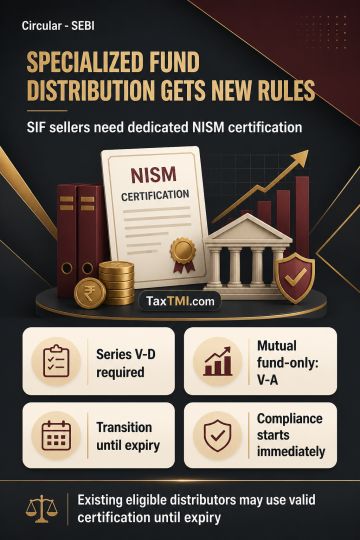
Specialized Investment Fund distribution now requires dedicated certification, while transitional recognition preserves existing qualified distributor...
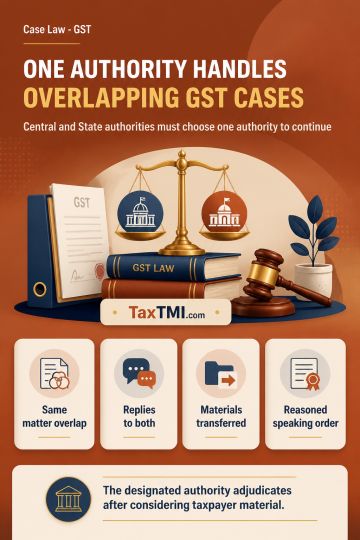
Overlapping GST proceedings require Central and State authorities to designate one competent authority for coordinated adjudication of the same matter...
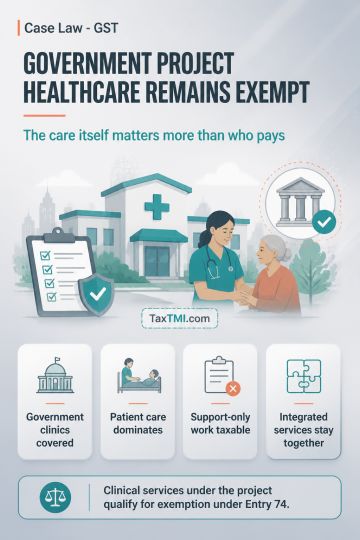
Composite healthcare supplies retain exemption when patient care is the contract's essential character, despite payment through an implementing agency...
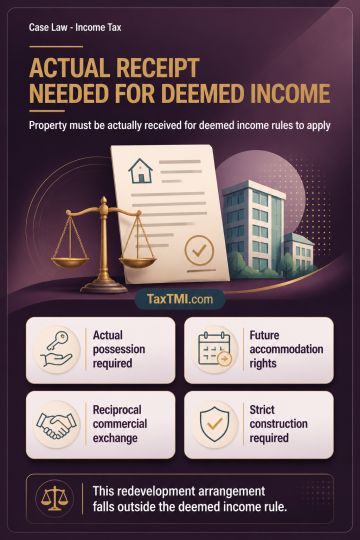
Receipt of immovable property requires actual possession or enjoyment; redevelopment allotments exchanged for tenancy rights fall outside deemed incom...
Page of 4796
Press 'Enter' after typing page number.
841 to 860 of 95916 Results
❮
❯
❯❯
0 / 200
Expand Note
Add to Folder
No Folders have been created
+
Are you sure you want to delete "My most important" ?
The Income Tax Appellate Tribunal (ITAT) examined the taxability of income from a discretionary trust u/s 164(1) read with clause (ii) of Explanation 1 to Section 164 of the Income Tax Act, 1961. The key points are: Since the trustees have absolute discretion to apply the trust's income and corpus, and the beneficiaries' shares are not determined, the trust is considered a discretionary trust. The income is taxable at the maximum marginal rate as if it were the total income of an association of persons (AOP). However, the beneficiaries, being individuals, cannot be denied deductions u/ss 80C and 80TTA due to the deeming fiction of AOP. The Assessing Officer must consider allowing credit for TDS and deduction u/s 80C after verification. The ITAT emphasized that the correct income must be taxed strictly per the Act, regardless of any deficiencies in the prescribed ITR forms. The assessee's appeal was partly allowed.
The Income Tax Appellate Tribunal (ITAT) examined the taxability of income from a discretionary trust u/s 164(1) read with clause (ii) of Explanation 1 to Section 164 of the Income Tax Act, 1961. The key points are: Since the trustees have absolute discretion to apply the trust's income and corpus, and the beneficiaries' shares are not determined, the trust is considered a discretionary trust. The income is taxable at the maximum marginal rate as if it were the total income of an association of persons (AOP). However, the beneficiaries, being individuals, cannot be denied deductions u/ss 80C and 80TTA due to the deeming fiction of AOP. The Assessing Officer must consider allowing credit for TDS and deduction u/s 80C after verification. The ITAT emphasized that the correct income must be taxed strictly per the Act, regardless of any deficiencies in the prescribed ITR forms. The assessee's appeal was partly allowed.
Note: It is a system-generated summary and is for quick reference only.
 TaxTMI
 of 4796






 Join Channel


 TaxTMI