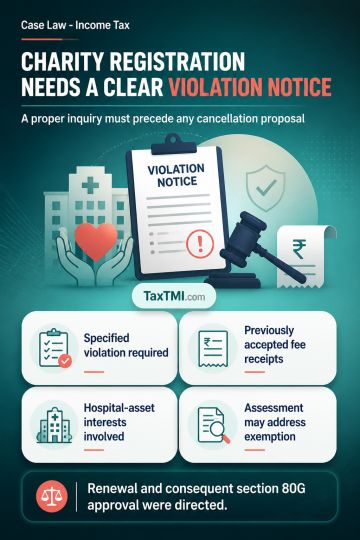
Charitable trust registration requires a specified-violation notice; settled cash deposits and related-party payments did not justify cancellation or ...
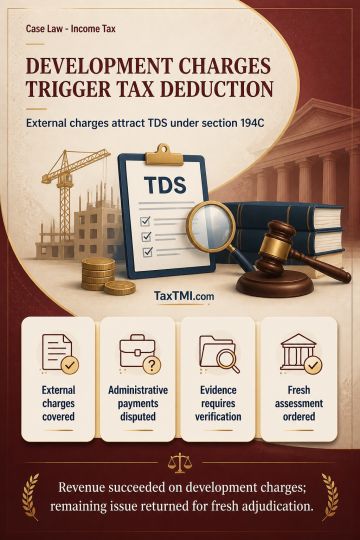
External development charges trigger TDS under section 194C, while disputed administrative payments require factual verification and fresh adjudicatio...
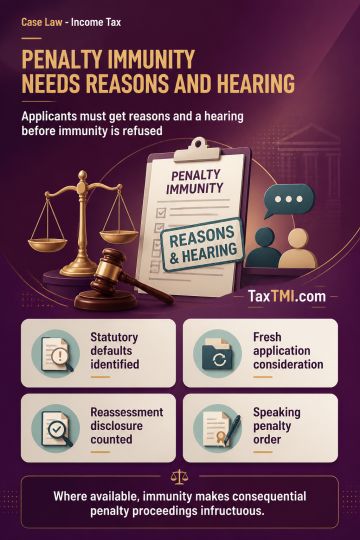
Section 270AA penalty immunity requires identified statutory defaults and a hearing before rejection; reassessment disclosure may constitute under-rep...
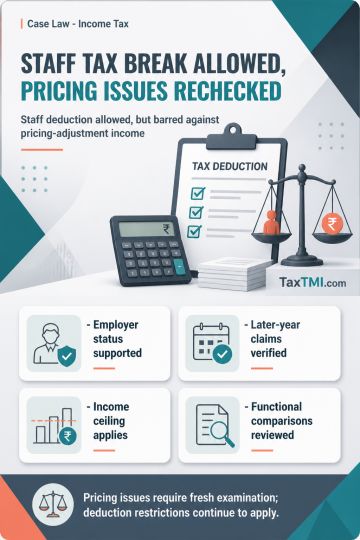
Section 80JJAA employee-cost deduction allowed for deployed staff but barred against transfer-pricing income enhancement, with pricing issues remanded...
Transfer-pricing methodology protects commercially genuine associated-enterprise payments, while pre-2016 secondary adjustments and related notional i...
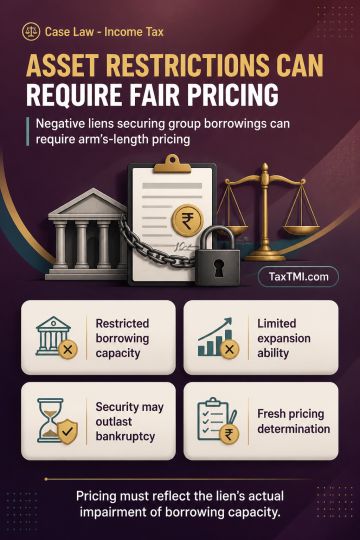
Negative liens over operating assets can constitute international transactions requiring arm's-length pricing reflecting restricted borrowing and expa...
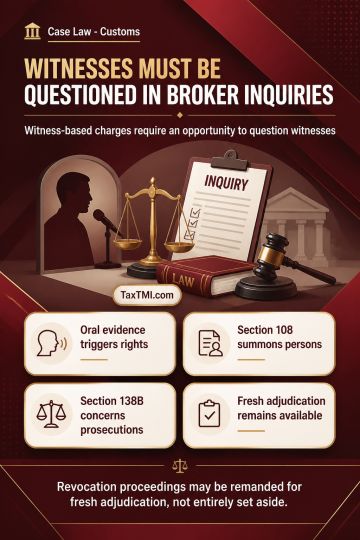
Cross-examination rights in Customs Broker revocation inquiries require witness examination; procedural denial may be cured through fresh adjudication...
In the context of an appeal u/s 37(1)(c) of the Arbitration Act,...
Appellate Court's remand power u/s 37(1)(c) to be used sparingly. Narrow scope of interference u/s 34 & 37. Multiple grounds waste time & increase pendency.
Contents
Summary
Note
Bookmark
Share
✓ Copied successfully !
Print
Print Options
For full text, please login
Login to TaxTMI
Verification Pending
The Email Id has not been verified. Click on the link we have sent on
In the context of an appeal u/s 37(1)(c) of the Arbitration Act, the Court held that while the Appellate Court has the power to remand the matter to the Section 34 Court, this power should be exercised sparingly and only in exceptional circumstances where remand is unavoidable. Routinely passing remand orders would defeat the object of the Arbitration Act by causing delay and increased costs. The scope of interference u/s 34 is narrow, and the jurisdiction u/s 37 is even narrower. The Court cautioned against raising multiple grounds not covered by Section 34, as it wastes the Court's time and contributes to pendency. The appeal was partly allowed, and the matter was listed for further hearing.
In the context of an appeal u/s 37(1)(c) of the Arbitration Act, the Court held that while the Appellate Court has the power to remand the matter to the Section 34 Court, this power should be exercised sparingly and only in exceptional circumstances where remand is unavoidable. Routinely passing remand orders would defeat the object of the Arbitration Act by causing delay and increased costs. The scope of interference u/s 34 is narrow, and the jurisdiction u/s 37 is even narrower. The Court cautioned against raising multiple grounds not covered by Section 34, as it wastes the Court's time and contributes to pendency. The appeal was partly allowed, and the matter was listed for further hearing.
Note: It is a system-generated summary and is for quick reference only.
 TaxTMI
  TaxTMI
 of 4828















 Join Channel


