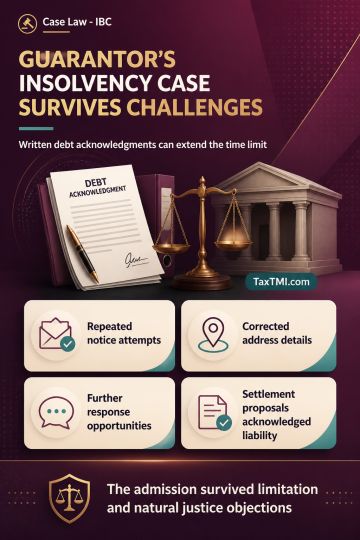
Service of notice and contractual debt acknowledgment preserved insolvency admission against a corporate guarantor despite limitation and natural just...
Original works exemption excludes standalone boulder transportation, leaving subcontracted railway-project transport services subject to service tax l...
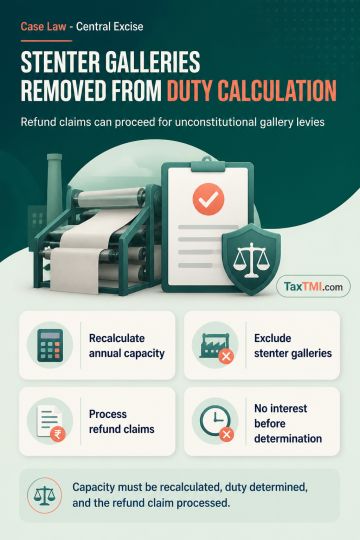
Annual production capacity determinations excluding stenter galleries support refunds for unconstitutional excise levies without an unjust-enrichment ...
Vicarious liability for cheque dishonour requires specific allegations of responsibility and cheque signatory; generic director allegations cannot sus...
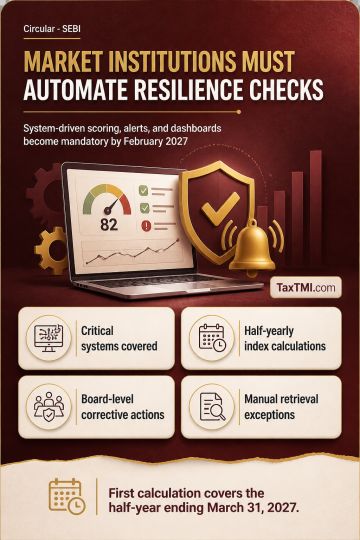
IT Resilience Index requires market infrastructure institutions to automate resilience scoring, early warnings, and continuous service-delivery monito...
The case involved determining whether gains from the sale of shares allotted in an IPO should be classified as Short-Term Capital Gains (STCG) or business income. The principle of consistency was emphasized, with CBDT Circular stating that if shares are treated as investments, income from their transfer should be considered capital gains. The CBDT Circular aimed to reduce litigation and uncertainty. The Revenue's change in treatment without valid reason was deemed incorrect. Court precedents supported treating such gains as capital gains when shares were held as investments. The Revenue's classification of the gains as business income was overturned, and the gains were treated as STCG, following the principle of consistency. The appeal by the assessee was allowed.
The case involved determining whether gains from the sale of shares allotted in an IPO should be classified as Short-Term Capital Gains (STCG) or business income. The principle of consistency was emphasized, with CBDT Circular stating that if shares are treated as investments, income from their transfer should be considered capital gains. The CBDT Circular aimed to reduce litigation and uncertainty. The Revenue's change in treatment without valid reason was deemed incorrect. Court precedents supported treating such gains as capital gains when shares were held as investments. The Revenue's classification of the gains as business income was overturned, and the gains were treated as STCG, following the principle of consistency. The appeal by the assessee was allowed.
Note: It is a system-generated summary and is for quick reference only.
 TaxTMI
  TaxTMI
 of 4828











 Join Channel