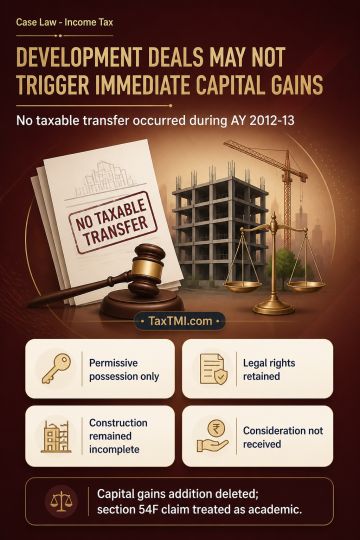
Development agreements require legal possession or effective enjoyment for capital gains transfer; permissive possession and deferred consideration de...
Prolonged sterilisation of development rights supports capital-gains treatment, while business-income disallowances cannot govern capital-gains comput...
Additional evidence in transfer pricing dispute leads to fresh examination, while tax deductions, TDS credit, fee and refund interest require verifica...
Category II AIF pass-through taxation preserves non-business income character; investment receipts cannot be reclassified without applying recognised ...
The National Company Law Appellate Tribunal, New Delhi, addressed the admissibility of a section 9 application for initiation of Corporate Insolvency Resolution Process (CIRP) in the presence of pre-existing disputes between the parties. Referring to the Supreme Court's ruling in Mobilox Innovations Pvt Ltd Vs Kirusa Software Pvt Ltd, it was emphasized that a pre-existing dispute must be more than a feeble legal argument or unsupported assertion. The Tribunal noted that the existence of claims or counterclaims, even without a reply to a demand notice, could establish a pre-existing dispute warranting rejection of a Section 9 petition. In this case, the Corporate Debtor had already initiated arbitration proceedings prior to the Section 9 petition, indicating a pre-existing dispute that could not be resolved summarily. Consequently, the Tribunal allowed the appeal and directed the dismissal of the Section 9 petition.
The National Company Law Appellate Tribunal, New Delhi, addressed the admissibility of a section 9 application for initiation of Corporate Insolvency Resolution Process (CIRP) in the presence of pre-existing disputes between the parties. Referring to the Supreme Court's ruling in Mobilox Innovations Pvt Ltd Vs Kirusa Software Pvt Ltd, it was emphasized that a pre-existing dispute must be more than a feeble legal argument or unsupported assertion. The Tribunal noted that the existence of claims or counterclaims, even without a reply to a demand notice, could establish a pre-existing dispute warranting rejection of a Section 9 petition. In this case, the Corporate Debtor had already initiated arbitration proceedings prior to the Section 9 petition, indicating a pre-existing dispute that could not be resolved summarily. Consequently, the Tribunal allowed the appeal and directed the dismissal of the Section 9 petition.
Note: It is a system-generated summary and is for quick reference only.
 TaxTMI
 of 4805

















 Join Channel


 TaxTMI
