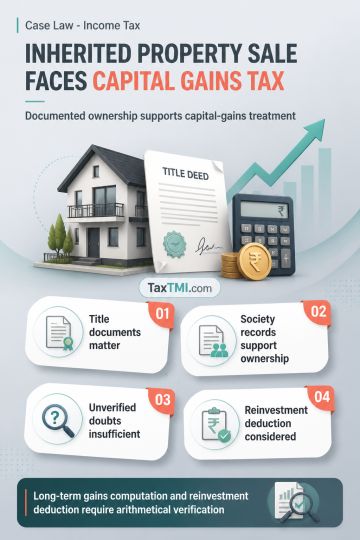
Inherited property sale proceeds require capital-gains treatment where ownership is supported by evidence, not suspicion or unverified signature doubt...
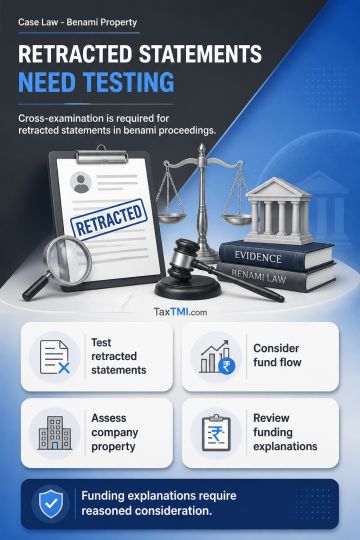
Cross-examination of retracted statements is essential where foundational evidence supports a benami allegation and documented funding explanations re...
Capital-goods exemption covers plant-modernisation accessories, while the import restriction applies only to earlier capital-goods components and spar...
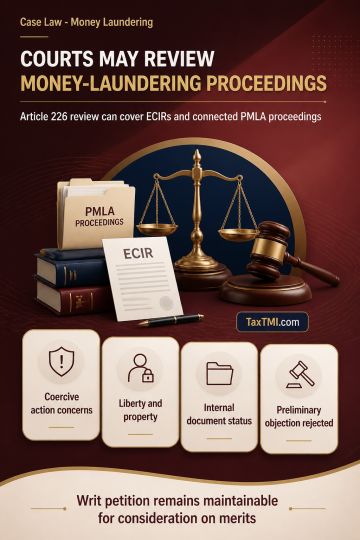
Constitutional judicial review permits challenges to ECIRs and connected money-laundering proceedings where coercive action affects fundamental intere...
The Madras High Court addressed a case involving best judgment assessment due to the petitioner's failure to file GST returns within the prescribed time limit. The court noted that the limitation period for filing returns was extended to 120 days from 30 days, effective from 01.10.2023. However, traders prior to this period were not eligible for the extended timeframe. The petitioner argued that the actual tax liability was Rs. 2 lakhs, paid belatedly in August 2023, while the best judgment amount was Rs. 5 lakhs. The court allowed the petitioner to apply for condonation of delay, showing a sympathetic approach, and disposed of the writ petition accordingly.
The Madras High Court addressed a case involving best judgment assessment due to the petitioner's failure to file GST returns within the prescribed time limit. The court noted that the limitation period for filing returns was extended to 120 days from 30 days, effective from 01.10.2023. However, traders prior to this period were not eligible for the extended timeframe. The petitioner argued that the actual tax liability was Rs. 2 lakhs, paid belatedly in August 2023, while the best judgment amount was Rs. 5 lakhs. The court allowed the petitioner to apply for condonation of delay, showing a sympathetic approach, and disposed of the writ petition accordingly.
Note: It is a system-generated summary and is for quick reference only.
 TaxTMI
 of 4786










 Join Channel


 TaxTMI