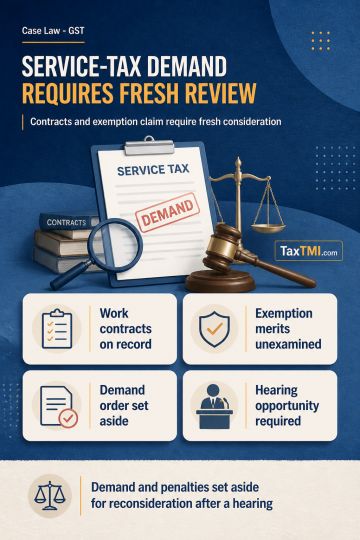
Governmental authority status supports construction-service exemption, while pre-cutoff contract and stamp-duty compliance requires verification on re...
Automated Free Sale and Commerce Certificates enable paperless processing while retaining risk-based manual verification for selected exporter applica...
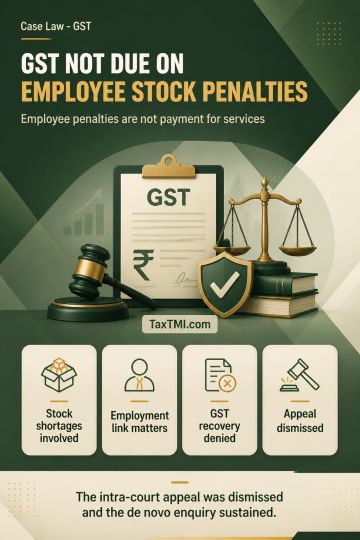
Employee stock-shortage penalties do not constitute consideration for services, preventing GST collection under Schedule II in employment relationship...
The original appellant (now deceased) was represented by her son as her legal representative. The suit initially sought a permanent prohibitory injunction regarding a property, asserting her exclusive ownership and possession against the defendants, who are other family members. - Upon the death of the original appellant, her son sought to substitute himself as the appellant, claiming inheritance rights. - The Court noted the difference in scenarios where the plaintiff versus the defendant dies. While an injunction becomes moot if a defendant dies (since it cannot bind the heirs unless explicitly directed), the same does not apply when a plaintiff dies. - The High Court held that the cause of action for an injunction does not necessarily die with the plaintiff. If the legal heirs can establish a legitimate claim to the property, they may continue to seek injunctions to protect their possession.
The original appellant (now deceased) was represented by her son as her legal representative. The suit initially sought a permanent prohibitory injunction regarding a property, asserting her exclusive ownership and possession against the defendants, who are other family members. - Upon the death of the original appellant, her son sought to substitute himself as the appellant, claiming inheritance rights. - The Court noted the difference in scenarios where the plaintiff versus the defendant dies. While an injunction becomes moot if a defendant dies (since it cannot bind the heirs unless explicitly directed), the same does not apply when a plaintiff dies. - The High Court held that the cause of action for an injunction does not necessarily die with the plaintiff. If the legal heirs can establish a legitimate claim to the property, they may continue to seek injunctions to protect their possession.
Note: It is a system-generated summary and is for quick reference only.
 TaxTMI
  TaxTMI
 of 4828











 Join Channel


