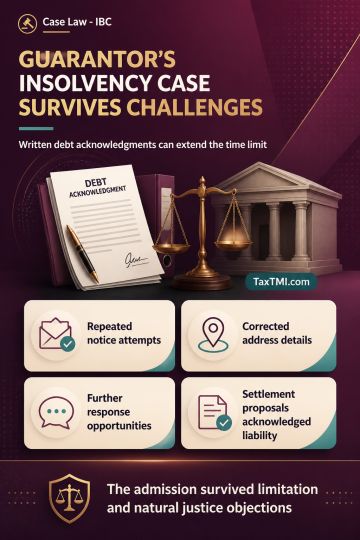
Service of notice and contractual debt acknowledgment preserved insolvency admission against a corporate guarantor despite limitation and natural just...
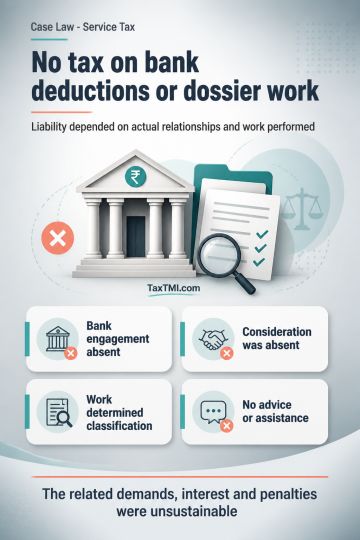
Original works exemption excludes standalone boulder transportation, leaving subcontracted railway-project transport services subject to service tax l...
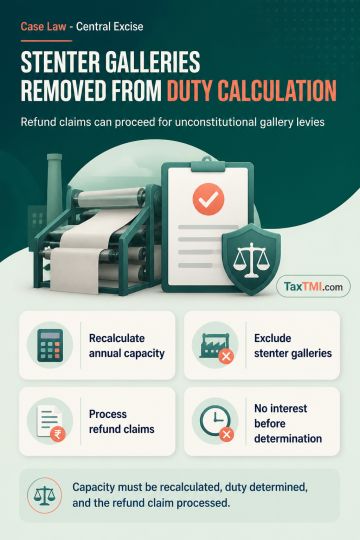
Annual production capacity determinations excluding stenter galleries support refunds for unconstitutional excise levies without an unjust-enrichment ...
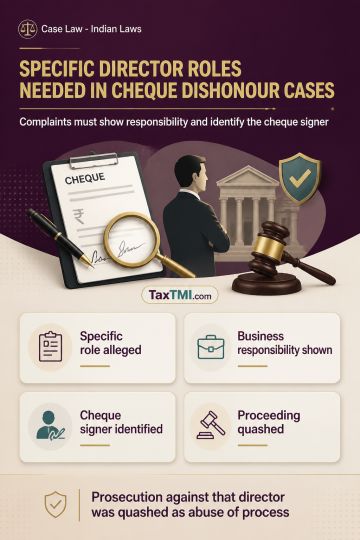
Vicarious liability for cheque dishonour requires specific allegations of responsibility and cheque signatory; generic director allegations cannot sus...
IT Resilience Index requires market infrastructure institutions to automate resilience scoring, early warnings, and continuous service-delivery monito...
The original appellant (now deceased) was represented by her son as her legal representative. The suit initially sought a permanent prohibitory injunction regarding a property, asserting her exclusive ownership and possession against the defendants, who are other family members. - Upon the death of the original appellant, her son sought to substitute himself as the appellant, claiming inheritance rights. - The Court noted the difference in scenarios where the plaintiff versus the defendant dies. While an injunction becomes moot if a defendant dies (since it cannot bind the heirs unless explicitly directed), the same does not apply when a plaintiff dies. - The High Court held that the cause of action for an injunction does not necessarily die with the plaintiff. If the legal heirs can establish a legitimate claim to the property, they may continue to seek injunctions to protect their possession.
The original appellant (now deceased) was represented by her son as her legal representative. The suit initially sought a permanent prohibitory injunction regarding a property, asserting her exclusive ownership and possession against the defendants, who are other family members. - Upon the death of the original appellant, her son sought to substitute himself as the appellant, claiming inheritance rights. - The Court noted the difference in scenarios where the plaintiff versus the defendant dies. While an injunction becomes moot if a defendant dies (since it cannot bind the heirs unless explicitly directed), the same does not apply when a plaintiff dies. - The High Court held that the cause of action for an injunction does not necessarily die with the plaintiff. If the legal heirs can establish a legitimate claim to the property, they may continue to seek injunctions to protect their possession.
Note: It is a system-generated summary and is for quick reference only.
 TaxTMI
  TaxTMI
 of 4828














 Join Channel