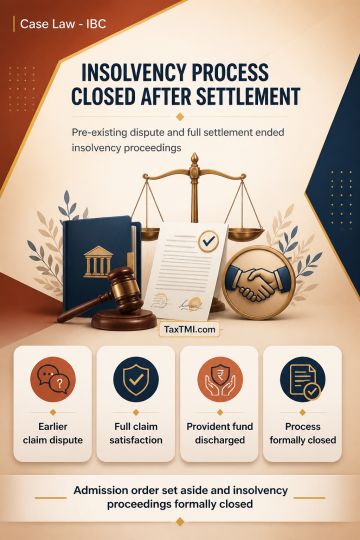
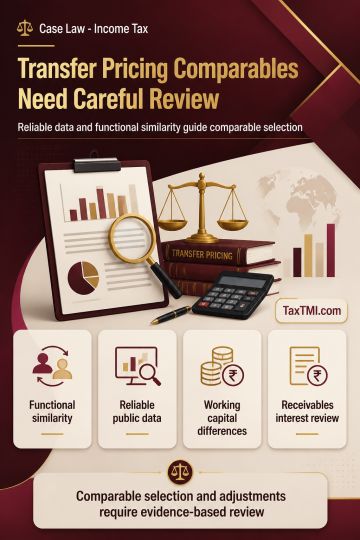
Transfer pricing comparability requires functional alignment, reliable financial data, and careful review of working capital and receivables adjustmen...
Transfer pricing rules require benchmarking corporate guarantees and associated-enterprise advances, while invalid domestic-transaction adjustments ca...
Prospective sugar export prohibition required registered letters of credit; private contracts and export quotas created no enforceable continuation ri...
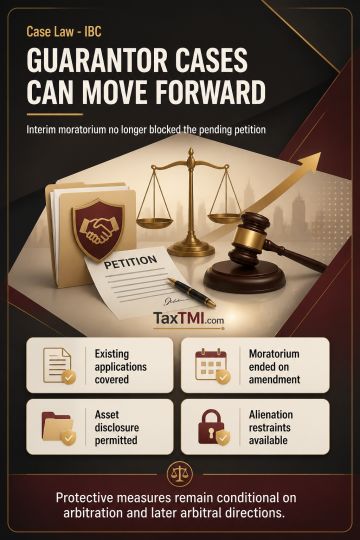
Retroactive interim-moratorium exclusion permits protective asset disclosure and preservation measures against personal guarantors pending arbitration...
Approval of scheme of amalgamation - Application of the "Alter Ego" Principle - Violation of Section 233 of the Companies Act, 2013 - requirement of holding at least ninety percent of the total numbers of shares - The complainant (opposite party) argued that the petitioner made a false declaration regarding the approval of the amalgamation scheme, misleading the authorities by stating that the scheme was approved by the requisite majority of members, which did not constitute 90% of total members but rather those present and voting. - The High Court hold that by targeting the petitioner (the Company Secretary) alone, without implicating the corporation or other responsible individuals, the prosecution is deemed to be fundamentally flawed and an abuse of the legal process. The petitioner, acting in his official capacity, should not bear sole responsibility for corporate actions unless specific wrongdoing on his part can be demonstrated.
Approval of scheme of amalgamation - Application of the "Alter Ego" Principle - Violation of Section 233 of the Companies Act, 2013 - requirement of holding at least ninety percent of the total numbers of shares - The complainant (opposite party) argued that the petitioner made a false declaration regarding the approval of the amalgamation scheme, misleading the authorities by stating that the scheme was approved by the requisite majority of members, which did not constitute 90% of total members but rather those present and voting. - The High Court hold that by targeting the petitioner (the Company Secretary) alone, without implicating the corporation or other responsible individuals, the prosecution is deemed to be fundamentally flawed and an abuse of the legal process. The petitioner, acting in his official capacity, should not bear sole responsibility for corporate actions unless specific wrongdoing on his part can be demonstrated.
Note: It is a system-generated summary and is for quick reference only.
 TaxTMI
 of 4782














 Join Channel


 TaxTMI