Additional evidence in transfer pricing dispute leads to fresh examination, while tax deductions, TDS credit, fee and refund interest require verifica...
Category II AIF pass-through taxation preserves non-business income character; investment receipts cannot be reclassified without applying recognised ...
Mutual fund maturity rules require proper rollover, redemption, disclosure, and due diligence; investor gains cannot excuse regulatory breaches or pen...
Threshold exemption excludes exempt services, while stamp-paper purchases avoid reverse charge; consequential service tax penalties were also set asid...
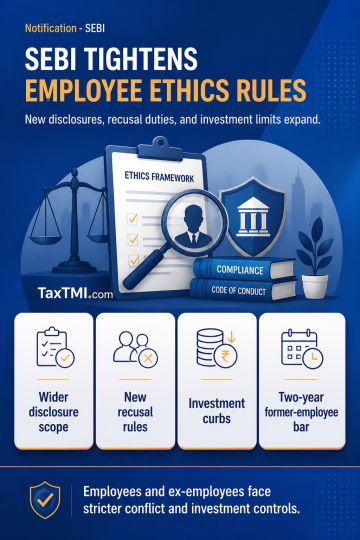
Employee conflict disclosures and investment restrictions expand with new recusal duties, post-employment limits, and compliance reporting requirement...
Approval of scheme of amalgamation - Application of the "Alter Ego" Principle - Violation of Section 233 of the Companies Act, 2013 - requirement of holding at least ninety percent of the total numbers of shares - The complainant (opposite party) argued that the petitioner made a false declaration regarding the approval of the amalgamation scheme, misleading the authorities by stating that the scheme was approved by the requisite majority of members, which did not constitute 90% of total members but rather those present and voting. - The High Court hold that by targeting the petitioner (the Company Secretary) alone, without implicating the corporation or other responsible individuals, the prosecution is deemed to be fundamentally flawed and an abuse of the legal process. The petitioner, acting in his official capacity, should not bear sole responsibility for corporate actions unless specific wrongdoing on his part can be demonstrated.
Approval of scheme of amalgamation - Application of the "Alter Ego" Principle - Violation of Section 233 of the Companies Act, 2013 - requirement of holding at least ninety percent of the total numbers of shares - The complainant (opposite party) argued that the petitioner made a false declaration regarding the approval of the amalgamation scheme, misleading the authorities by stating that the scheme was approved by the requisite majority of members, which did not constitute 90% of total members but rather those present and voting. - The High Court hold that by targeting the petitioner (the Company Secretary) alone, without implicating the corporation or other responsible individuals, the prosecution is deemed to be fundamentally flawed and an abuse of the legal process. The petitioner, acting in his official capacity, should not bear sole responsibility for corporate actions unless specific wrongdoing on his part can be demonstrated.
Note: It is a system-generated summary and is for quick reference only.
 TaxTMI
 of 4803

















 Join Channel


 TaxTMI
