Statutory transfer formalities invalidated alleged share and property transfers, while retrospective record manipulation constituted oppression and mi...
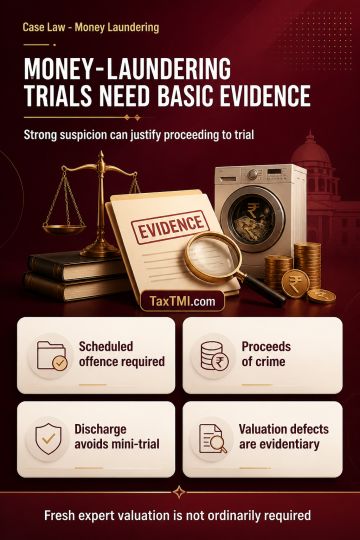
Provisional attachment of laundered funds and equivalent-value property sustained, with statutory protection limited to pension, gratuity and providen...
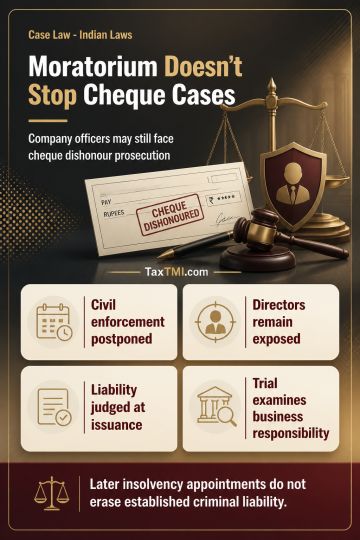
Insolvency moratorium does not shield company officers from cheque dishonour prosecution for liability arising before corporate insolvency proceedings...
Approval of scheme of amalgamation - Application of the "Alter Ego" Principle - Violation of Section 233 of the Companies Act, 2013 - requirement of holding at least ninety percent of the total numbers of shares - The complainant (opposite party) argued that the petitioner made a false declaration regarding the approval of the amalgamation scheme, misleading the authorities by stating that the scheme was approved by the requisite majority of members, which did not constitute 90% of total members but rather those present and voting. - The High Court hold that by targeting the petitioner (the Company Secretary) alone, without implicating the corporation or other responsible individuals, the prosecution is deemed to be fundamentally flawed and an abuse of the legal process. The petitioner, acting in his official capacity, should not bear sole responsibility for corporate actions unless specific wrongdoing on his part can be demonstrated.
Approval of scheme of amalgamation - Application of the "Alter Ego" Principle - Violation of Section 233 of the Companies Act, 2013 - requirement of holding at least ninety percent of the total numbers of shares - The complainant (opposite party) argued that the petitioner made a false declaration regarding the approval of the amalgamation scheme, misleading the authorities by stating that the scheme was approved by the requisite majority of members, which did not constitute 90% of total members but rather those present and voting. - The High Court hold that by targeting the petitioner (the Company Secretary) alone, without implicating the corporation or other responsible individuals, the prosecution is deemed to be fundamentally flawed and an abuse of the legal process. The petitioner, acting in his official capacity, should not bear sole responsibility for corporate actions unless specific wrongdoing on his part can be demonstrated.
Note: It is a system-generated summary and is for quick reference only.
 TaxTMI
 of 4792
















 Join Channel


 TaxTMI