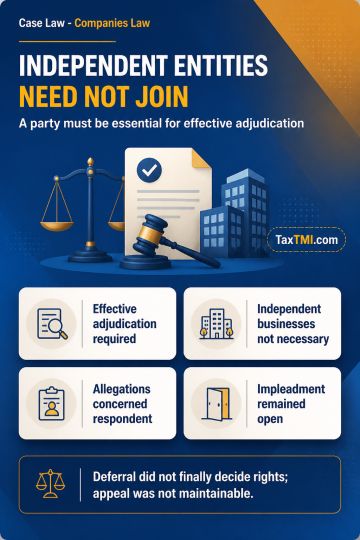
Necessary-party requirements limit impleadment of independent entities, while deferred consideration does not create an appealable adverse determinati...
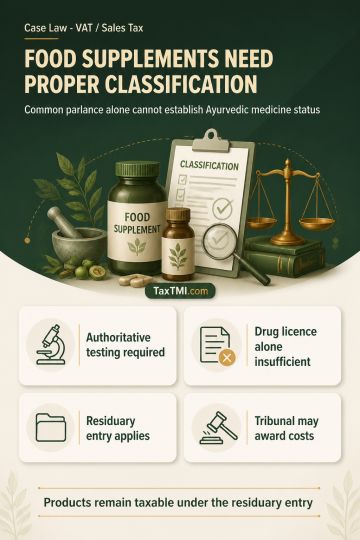
Food supplement classification requires common parlance and authoritative tests, preventing treatment as proprietary Ayurvedic medicines without suppo...
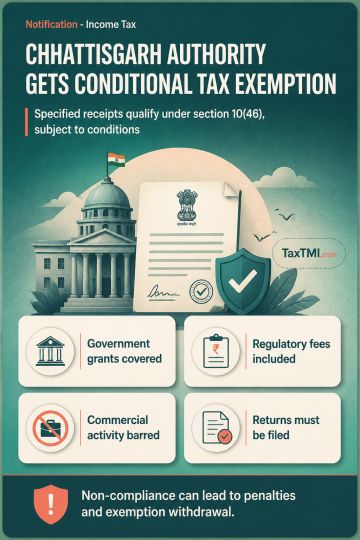
Specified regulatory authority income receives conditional tax exemption, subject to non-commercial activity, unchanged income character, and return f...
Tax exemption for regulatory authority income applies retrospectively, subject to non-commercial activity, unchanged income sources, and return-filing...
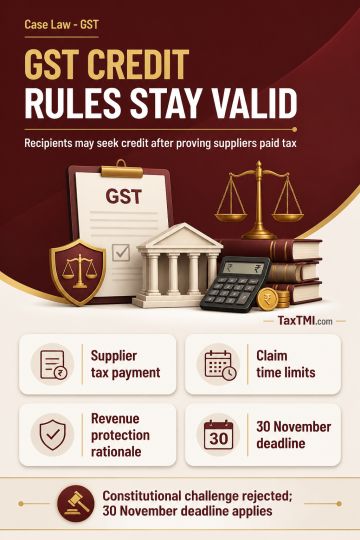
Input tax credit conditions remain constitutionally valid, with eligible recipient claims considered under GST circulars and retrospective filing dead...
Page of 4786
Press 'Enter' after typing page number.
401 to 420 of 95714 Results
❮
❯
❯❯
0 / 200
Expand Note
Add to Folder
No Folders have been created
+
Are you sure you want to delete "My most important" ?
Approval of scheme of amalgamation - Application of the "Alter Ego" Principle - Violation of Section 233 of the Companies Act, 2013 - requirement of holding at least ninety percent of the total numbers of shares - The complainant (opposite party) argued that the petitioner made a false declaration regarding the approval of the amalgamation scheme, misleading the authorities by stating that the scheme was approved by the requisite majority of members, which did not constitute 90% of total members but rather those present and voting. - The High Court hold that by targeting the petitioner (the Company Secretary) alone, without implicating the corporation or other responsible individuals, the prosecution is deemed to be fundamentally flawed and an abuse of the legal process. The petitioner, acting in his official capacity, should not bear sole responsibility for corporate actions unless specific wrongdoing on his part can be demonstrated.
Approval of scheme of amalgamation - Application of the "Alter Ego" Principle - Violation of Section 233 of the Companies Act, 2013 - requirement of holding at least ninety percent of the total numbers of shares - The complainant (opposite party) argued that the petitioner made a false declaration regarding the approval of the amalgamation scheme, misleading the authorities by stating that the scheme was approved by the requisite majority of members, which did not constitute 90% of total members but rather those present and voting. - The High Court hold that by targeting the petitioner (the Company Secretary) alone, without implicating the corporation or other responsible individuals, the prosecution is deemed to be fundamentally flawed and an abuse of the legal process. The petitioner, acting in his official capacity, should not bear sole responsibility for corporate actions unless specific wrongdoing on his part can be demonstrated.
Note: It is a system-generated summary and is for quick reference only.
 TaxTMI
 of 4786















 Join Channel


 TaxTMI