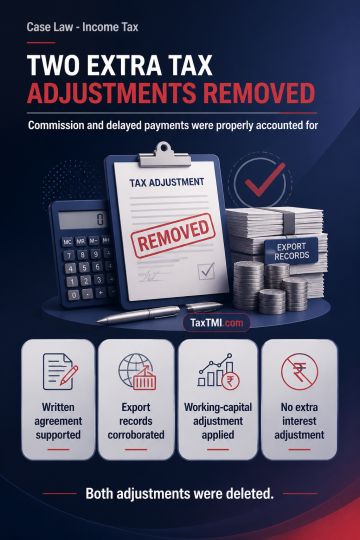
Pure reimbursement without income element escapes tax withholding, while delayed withholding and unsupported provisions face deferred or renewed scrut...
Public benefit requirement defeats charitable registration where residents' association services are reciprocal, member-only facilities governed by mu...
Exempt-income expenditure disallowance is confined to investments that actually generated exempt income, while supported business expenses remain dedu...
Objective characteristics and principal use govern mining-tyre classification, while fresh advance ruling applications may rely on additional technica...
High court power / jurisdiction to condone the delay - delay in filing an application seeking special leave to appeal against an acquittal. - After thorough consideration, the High court concluded that there is indeed power to condone the delay in such cases. - The court emphasized the precedential authority of a Supreme Court judgment, stating that it is binding on all courts unless distinguished, overruled, or set aside. The argument that the Supreme Court decision was inadequately considered was rejected. - The court analyzed the provisions of the Criminal Procedure Code and the Limitation Act, particularly regarding their applicability in appeals against acquittal. It concluded that Section 5 of the Limitation Act can be availed in such appeals.
High court power / jurisdiction to condone the delay - delay in filing an application seeking special leave to appeal against an acquittal. - After thorough consideration, the High court concluded that there is indeed power to condone the delay in such cases. - The court emphasized the precedential authority of a Supreme Court judgment, stating that it is binding on all courts unless distinguished, overruled, or set aside. The argument that the Supreme Court decision was inadequately considered was rejected. - The court analyzed the provisions of the Criminal Procedure Code and the Limitation Act, particularly regarding their applicability in appeals against acquittal. It concluded that Section 5 of the Limitation Act can be availed in such appeals.
Note: It is a system-generated summary and is for quick reference only.
 TaxTMI
  TaxTMI
 of 4811










 Join Channel


