Development agreements require legal possession or effective enjoyment for capital gains transfer; permissive possession and deferred consideration de...
Prolonged sterilisation of development rights supports capital-gains treatment, while business-income disallowances cannot govern capital-gains comput...
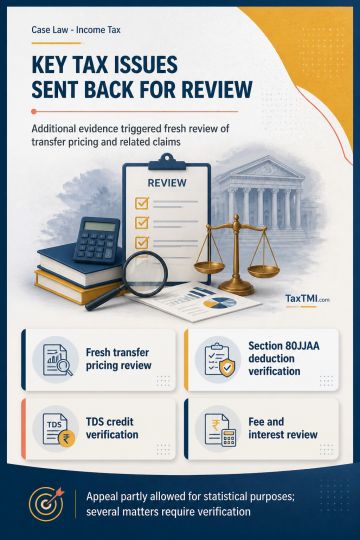
Additional evidence in transfer pricing dispute leads to fresh examination, while tax deductions, TDS credit, fee and refund interest require verifica...
Category II AIF pass-through taxation preserves non-business income character; investment receipts cannot be reclassified without applying recognised ...
Mutual fund maturity rules require proper rollover, redemption, disclosure, and due diligence; investor gains cannot excuse regulatory breaches or pen...
Ex-parte ad-interim injunction against the appellants - Defamatory Article authored by Defendant Nos. 3-5 and published by Defendant Nos. 1 and 2 as stated in the present Suit are defamatory to the Plaintiff - The Court dismissed the appeal, finding the ex-parte ad-interim injunction justified based on prima facie evidence and the balance of convenience favoring the respondent. The Court noted the importance of procedural adherence in granting such injunctions, emphasizing that the initial order was not arbitrary and was within legal bounds. - The Court emphasized the distinction between freedom of speech and defamation, underscoring the necessity of responsible journalism. It concluded that the appellants had not provided sufficient justification to refute the claims of defamation and upheld the injunction.
Ex-parte ad-interim injunction against the appellants - Defamatory Article authored by Defendant Nos. 3-5 and published by Defendant Nos. 1 and 2 as stated in the present Suit are defamatory to the Plaintiff - The Court dismissed the appeal, finding the ex-parte ad-interim injunction justified based on prima facie evidence and the balance of convenience favoring the respondent. The Court noted the importance of procedural adherence in granting such injunctions, emphasizing that the initial order was not arbitrary and was within legal bounds. - The Court emphasized the distinction between freedom of speech and defamation, underscoring the necessity of responsible journalism. It concluded that the appellants had not provided sufficient justification to refute the claims of defamation and upheld the injunction.
Note: It is a system-generated summary and is for quick reference only.
 TaxTMI
  TaxTMI
 of 4828





















 Join Channel