Charitable registration renewal cannot become an assessment of receipts, profitability or annual exemption compliance, requiring renewal and donation ...
AMP expenditure for own business is not an international transaction without an associated-enterprise arrangement, eliminating transfer pricing adjust...
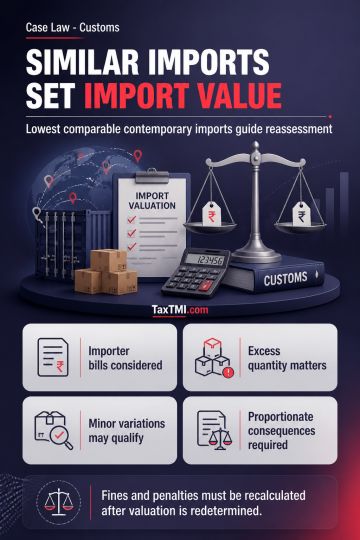
Customs valuation must use comparable contemporary imports, while confiscation fines and penalties require proportionate recalculation on reassessed v...
Depositor-protection proceedings prevail over corporate insolvency, while liquidators may recover chit receivables using copies of seized company reco...
Intermediary service classification fails where overseas admission facilitation is supplied independently, preserving export treatment and small-provi...
Satellite transponder bandwidth is telecommunication, not Business Support Service; foreign non-telegraph providers triggered no service tax liability...
Ex-parte ad-interim injunction against the appellants - Defamatory Article authored by Defendant Nos. 3-5 and published by Defendant Nos. 1 and 2 as stated in the present Suit are defamatory to the Plaintiff - The Court dismissed the appeal, finding the ex-parte ad-interim injunction justified based on prima facie evidence and the balance of convenience favoring the respondent. The Court noted the importance of procedural adherence in granting such injunctions, emphasizing that the initial order was not arbitrary and was within legal bounds. - The Court emphasized the distinction between freedom of speech and defamation, underscoring the necessity of responsible journalism. It concluded that the appellants had not provided sufficient justification to refute the claims of defamation and upheld the injunction.
Ex-parte ad-interim injunction against the appellants - Defamatory Article authored by Defendant Nos. 3-5 and published by Defendant Nos. 1 and 2 as stated in the present Suit are defamatory to the Plaintiff - The Court dismissed the appeal, finding the ex-parte ad-interim injunction justified based on prima facie evidence and the balance of convenience favoring the respondent. The Court noted the importance of procedural adherence in granting such injunctions, emphasizing that the initial order was not arbitrary and was within legal bounds. - The Court emphasized the distinction between freedom of speech and defamation, underscoring the necessity of responsible journalism. It concluded that the appellants had not provided sufficient justification to refute the claims of defamation and upheld the injunction.
Note: It is a system-generated summary and is for quick reference only.
 TaxTMI
  TaxTMI
 of 4814






















 Join Channel


