Statutory sanction for delayed reassessment requires approval from the prescribed authority; approval by an inferior authority invalidates jurisdictio...
Transfer pricing margin adjustments require matching treatment of non-operating income and related costs, with comparability issues reconsidered on ev...
Preliminary-expense amortisation and MAT exempt-income adjustments prevailed, while trademark costs and managerial remuneration require fresh verifica...
Export valuation requires contemporaneous evidence; unrelated invoices cannot prove overvaluation, and dual penalties on firm and partner are impermis...
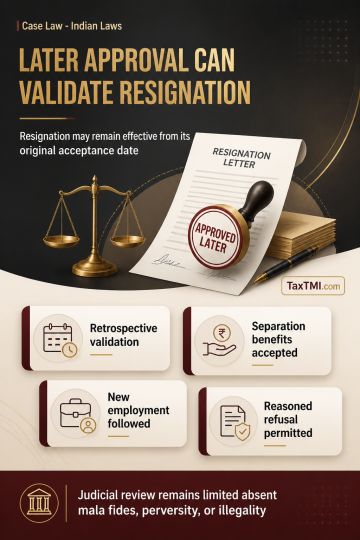
Ratification of resignation acceptance validates separation retrospectively, while withdrawal may be refused through reasoned administrative discretio...
Nature-dependent electricity contracts receive new Ind AS accounting, hedge designation, transition and financial-statement disclosure requirements fr...
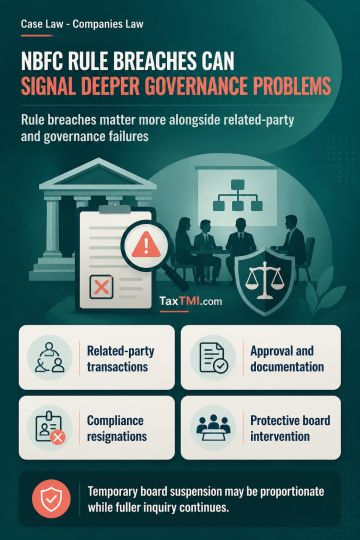
For an RBI-regulated NBFC, breach of binding prudential norms may constitute conduct prejudicial to the company or public interest when assessed cumulatively with related-party dealings, inadequate compliance controls and governance failures. Regulatory penalties do not necessarily preclude oppression and mismanagement jurisdiction, because regulatory supervision and corporate-protection remedies address distinct concerns. Transactions involving related parties require demonstrable approval, documentation, security and recovery arrangements; retrospective omnibus approval may not validate earlier transactions. Resignations of compliance personnel and removal of independent directors may be relevant indicators of weakened governance safeguards. Administrator-led intervention and temporary board suspension may be proportionate protective measures where no equally effective, less intrusive alternative prevents further prejudice pending fuller inquiry.
For an RBI-regulated NBFC, breach of binding prudential norms may constitute conduct prejudicial to the company or public interest when assessed cumulatively with related-party dealings, inadequate compliance controls and governance failures. Regulatory penalties do not necessarily preclude oppression and mismanagement jurisdiction, because regulatory supervision and corporate-protection remedies address distinct concerns. Transactions involving related parties require demonstrable approval, documentation, security and recovery arrangements; retrospective omnibus approval may not validate earlier transactions. Resignations of compliance personnel and removal of independent directors may be relevant indicators of weakened governance safeguards. Administrator-led intervention and temporary board suspension may be proportionate protective measures where no equally effective, less intrusive alternative prevents further prejudice pending fuller inquiry.
Note: It is a system-generated summary and is for quick reference only.
 TaxTMI
  TaxTMI
 of 4826
















 Join Channel