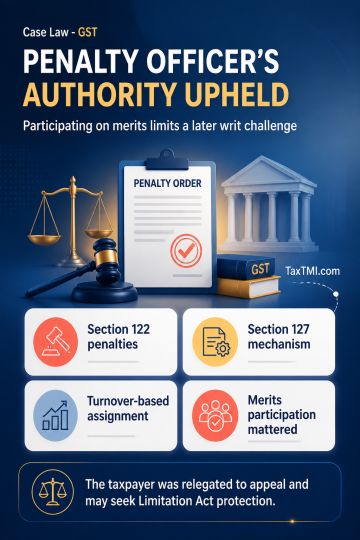
Proper-officer jurisdiction under UPGST penalty provisions upheld; participation on merits prevents bypassing the statutory appellate remedy through w...
Transitioned CENVAT credit may validly satisfy mandatory pre-deposit requirements for legacy service tax appeals through Electronic Credit Ledger debi...
Building-plan sanction charges require statutory authority; unauthorised fees and GST were quashed, while labour cess must follow prescribed collectio...
Pure-agent exclusion fails where hotel booking facilitators receive third-party services themselves, making entire customer consideration taxable as r...
Transfer pricing requires evidence for AMP transactions, functionally reliable comparables, and appropriate aggregation or Berry Ratio benchmarking me...
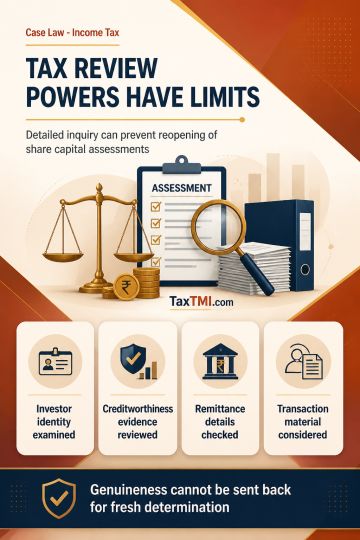
Revisionary jurisdiction cannot reopen share capital assessments where adequate inquiry supports a permissible view and no independent error is establ...
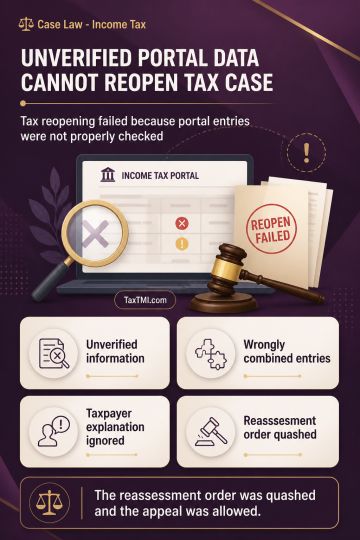
Reassessment jurisdiction fails where unverified portal information is aggregated without examining the taxpayer's explanation or relevance of entries...
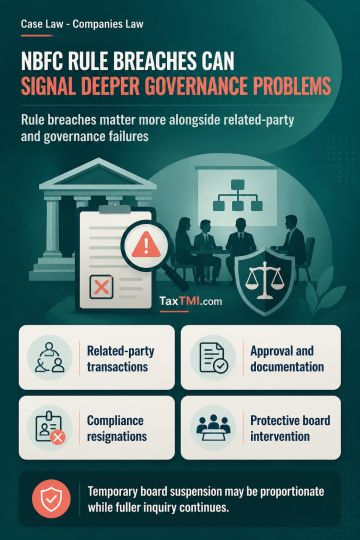
For an RBI-regulated NBFC, breach of binding prudential norms may constitute conduct prejudicial to the company or public interest when assessed cumulatively with related-party dealings, inadequate compliance controls and governance failures. Regulatory penalties do not necessarily preclude oppression and mismanagement jurisdiction, because regulatory supervision and corporate-protection remedies address distinct concerns. Transactions involving related parties require demonstrable approval, documentation, security and recovery arrangements; retrospective omnibus approval may not validate earlier transactions. Resignations of compliance personnel and removal of independent directors may be relevant indicators of weakened governance safeguards. Administrator-led intervention and temporary board suspension may be proportionate protective measures where no equally effective, less intrusive alternative prevents further prejudice pending fuller inquiry.
For an RBI-regulated NBFC, breach of binding prudential norms may constitute conduct prejudicial to the company or public interest when assessed cumulatively with related-party dealings, inadequate compliance controls and governance failures. Regulatory penalties do not necessarily preclude oppression and mismanagement jurisdiction, because regulatory supervision and corporate-protection remedies address distinct concerns. Transactions involving related parties require demonstrable approval, documentation, security and recovery arrangements; retrospective omnibus approval may not validate earlier transactions. Resignations of compliance personnel and removal of independent directors may be relevant indicators of weakened governance safeguards. Administrator-led intervention and temporary board suspension may be proportionate protective measures where no equally effective, less intrusive alternative prevents further prejudice pending fuller inquiry.
Note: It is a system-generated summary and is for quick reference only.
 TaxTMI
  TaxTMI
 of 4826

















 Join Channel