Opportunity to respond to jurisdictional reports is mandatory before customs settlement duty enhancement; connected applications require consistent ad...
Specific customs headings for scaffolding components prevail over general classification, invalidating misclassification proceedings and enabling with...
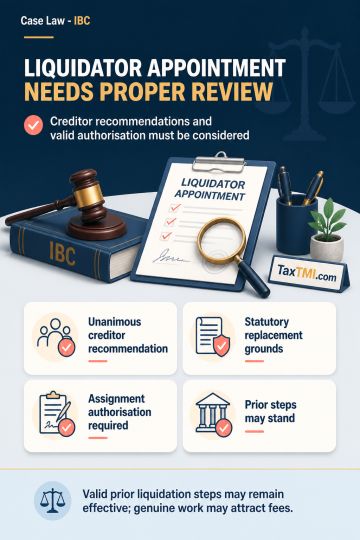
Liquidator appointment under Section 34 requires consideration of creditor recommendations, valid professional authorisation, and preservation of vali...
Income-tax exemption for specified regulatory fees and government grants applies subject to non-commercial activity and continuing compliance conditio...
Digital accessibility audit and remediation deadlines extended, while all other disability-compliance obligations for regulated entities remain unchan...
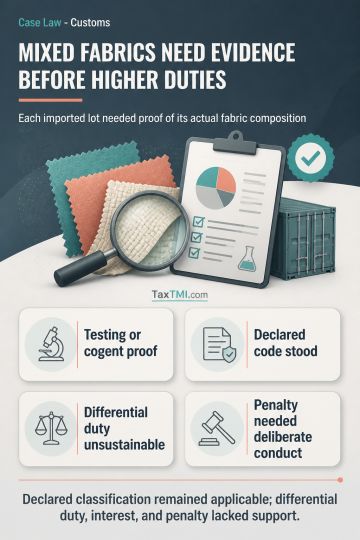
Tariff classification of imported mixed lots of polyester knitted fabrics requires evidence of the actual composition of goods covered by each Bill of Entry. A description as "polyester knitted fabric" does not, without testing or other cogent evidence, establish the characteristics needed to reclassify mixed assorted fabrics as fabrics of synthetic fibres. The declared classification under CTH 6006 9000 remained applicable, and the proposed classification under CTH 6006 3200, with differential duty and interest, was unsustainable. Penalty for misclassification also required proof of deliberate suppression, wilful misstatement, or intent to evade duty; an interpretational classification dispute did not establish those elements.
Tariff classification of imported mixed lots of polyester knitted fabrics requires evidence of the actual composition of goods covered by each Bill of Entry. A description as "polyester knitted fabric" does not, without testing or other cogent evidence, establish the characteristics needed to reclassify mixed assorted fabrics as fabrics of synthetic fibres. The declared classification under CTH 6006 9000 remained applicable, and the proposed classification under CTH 6006 3200, with differential duty and interest, was unsustainable. Penalty for misclassification also required proof of deliberate suppression, wilful misstatement, or intent to evade duty; an interpretational classification dispute did not establish those elements.
Note: It is a system-generated summary and is for quick reference only.
 TaxTMI
  TaxTMI
 of 4824

















 Join Channel