Arrest safeguards and transit remand requirements invalidated detention following inter-State transfer without communicated grounds or magistrate auth...
Arrest safeguards require disclosed grounds, relative intimation and transit remand, while duplicate prosecution under the CGST framework is unsustain...
Document Identification Number defects can invalidate GST assessments, with delayed challenges entertained conditionally where patent irregularities e...
Windmill commissioning evidence supported higher depreciation where grid connection and electricity generation proved operational use before the relev...
Pharmaceutical promotion and transfer-pricing comparability principles limited disallowances, while uncorroborated search allegations and unsupported ...
Business expenditure substantiation supports scrap credits, statutory payments and expense claims, while depreciation requires proof of actual busines...
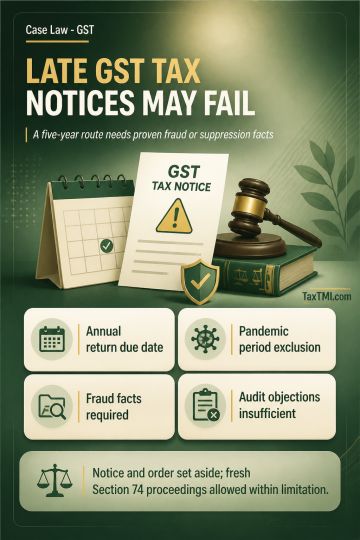
GST demand limitation under Section 73 runs from the due date for the annual return; extensions of those due dates change its commencement, and pandemic-period exclusion must be applied when calculating the three-year period. A notice issued after the resulting deadline cannot be sustained under the ordinary limitation. Recourse to Section 74's five-year period requires the Assessing Officer's satisfaction, based on disclosed foundational facts, that fraud, wilful misstatement or suppression caused the tax shortfall or excess input tax credit. Audit objections and bare statutory assertions are insufficient. The show-cause notice and consequential order were set aside, with liberty for fresh Section 74 proceedings within the applicable extended limitation.
GST demand limitation under Section 73 runs from the due date for the annual return; extensions of those due dates change its commencement, and pandemic-period exclusion must be applied when calculating the three-year period. A notice issued after the resulting deadline cannot be sustained under the ordinary limitation. Recourse to Section 74's five-year period requires the Assessing Officer's satisfaction, based on disclosed foundational facts, that fraud, wilful misstatement or suppression caused the tax shortfall or excess input tax credit. Audit objections and bare statutory assertions are insufficient. The show-cause notice and consequential order were set aside, with liberty for fresh Section 74 proceedings within the applicable extended limitation.
Note: It is a system-generated summary and is for quick reference only.
 TaxTMI
  TaxTMI
 of 4817






















 Join Channel