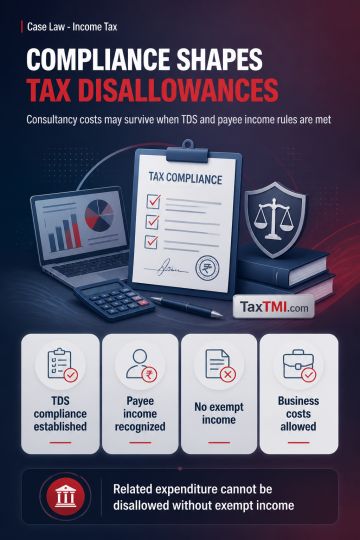
Tax deduction compliance and payee income recognition govern consultancy disallowance, while no exempt income prevents related expenditure disallowanc...
Derivative abetment liability fails when correctly declared imported components establish no underlying improper importation by the principal importer...
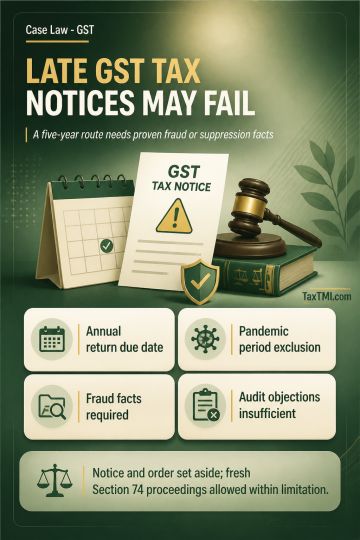
GST demand limitation under Section 73 runs from the due date for the annual return; extensions of those due dates change its commencement, and pandemic-period exclusion must be applied when calculating the three-year period. A notice issued after the resulting deadline cannot be sustained under the ordinary limitation. Recourse to Section 74's five-year period requires the Assessing Officer's satisfaction, based on disclosed foundational facts, that fraud, wilful misstatement or suppression caused the tax shortfall or excess input tax credit. Audit objections and bare statutory assertions are insufficient. The show-cause notice and consequential order were set aside, with liberty for fresh Section 74 proceedings within the applicable extended limitation.
GST demand limitation under Section 73 runs from the due date for the annual return; extensions of those due dates change its commencement, and pandemic-period exclusion must be applied when calculating the three-year period. A notice issued after the resulting deadline cannot be sustained under the ordinary limitation. Recourse to Section 74's five-year period requires the Assessing Officer's satisfaction, based on disclosed foundational facts, that fraud, wilful misstatement or suppression caused the tax shortfall or excess input tax credit. Audit objections and bare statutory assertions are insufficient. The show-cause notice and consequential order were set aside, with liberty for fresh Section 74 proceedings within the applicable extended limitation.
Note: It is a system-generated summary and is for quick reference only.
 TaxTMI
  TaxTMI
 of 4817












 Join Channel