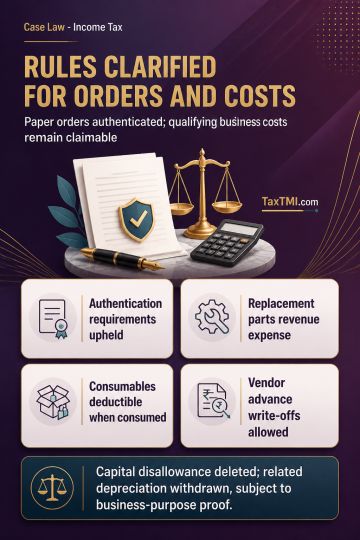
Authentication of paper assessment orders upheld, while qualifying repairs, consumables and vendor advance write-offs remain deductible business claim...
Transaction value cannot be rejected solely on non-statutory valuation guidelines without corroborative evidence supporting reassessment of final cust...
Cross-examination rights and corroborated evidence limit customs penalties for misdeclaration in genuine import transactions involving documented clea...
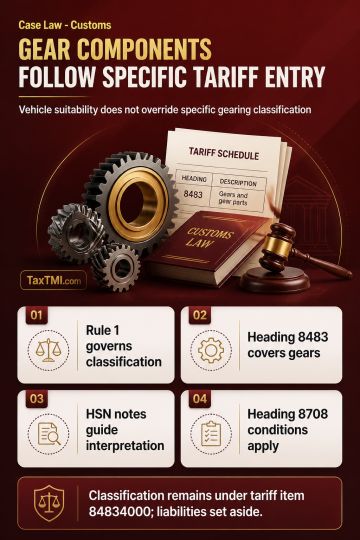
Tariff classification of vehicle gear components follows the specific gearing entry, displacing motor-vehicle parts classification and related liabili...
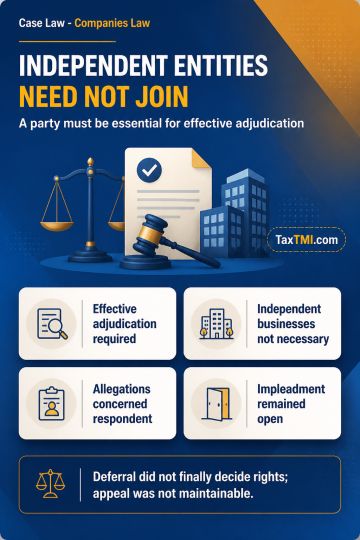
Necessary-party requirements limit impleadment of independent entities, while deferred consideration does not create an appealable adverse determinati...
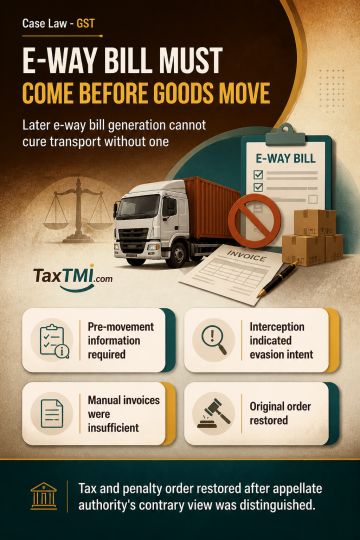
Rule 138(1) requires prescribed information to be furnished and an e-way bill generated before taxable goods begin moving. Transport without an e-way bill at interception was treated as establishing intent to evade tax, because later online generation could not cure the failure of statutory monitoring or prevent potential account manipulation. A manually issued invoice was not regarded as an equivalent safeguard. The appellate authority's contrary reliance on precedent was distinguished, and the original tax and penalty order under the detention provisions was restored.
Rule 138(1) requires prescribed information to be furnished and an e-way bill generated before taxable goods begin moving. Transport without an e-way bill at interception was treated as establishing intent to evade tax, because later online generation could not cure the failure of statutory monitoring or prevent potential account manipulation. A manually issued invoice was not regarded as an equivalent safeguard. The appellate authority's contrary reliance on precedent was distinguished, and the original tax and penalty order under the detention provisions was restored.
Note: It is a system-generated summary and is for quick reference only.
 TaxTMI
  TaxTMI
 of 4821


















 Join Channel