Opportunity to respond to jurisdictional reports is mandatory before customs settlement duty enhancement; connected applications require consistent ad...
Specific customs headings for scaffolding components prevail over general classification, invalidating misclassification proceedings and enabling with...
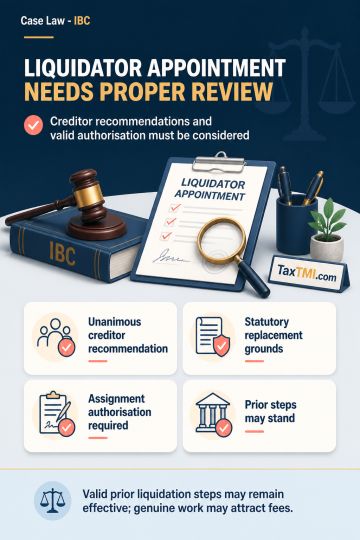
Liquidator appointment under Section 34 requires consideration of creditor recommendations, valid professional authorisation, and preservation of vali...
Income-tax exemption for specified regulatory fees and government grants applies subject to non-commercial activity and continuing compliance conditio...
Digital accessibility audit and remediation deadlines extended, while all other disability-compliance obligations for regulated entities remain unchan...
Rule 138(1) requires prescribed information to be furnished and an e-way bill generated before taxable goods begin moving. Transport without an e-way bill at interception was treated as establishing intent to evade tax, because later online generation could not cure the failure of statutory monitoring or prevent potential account manipulation. A manually issued invoice was not regarded as an equivalent safeguard. The appellate authority's contrary reliance on precedent was distinguished, and the original tax and penalty order under the detention provisions was restored.
Rule 138(1) requires prescribed information to be furnished and an e-way bill generated before taxable goods begin moving. Transport without an e-way bill at interception was treated as establishing intent to evade tax, because later online generation could not cure the failure of statutory monitoring or prevent potential account manipulation. A manually issued invoice was not regarded as an equivalent safeguard. The appellate authority's contrary reliance on precedent was distinguished, and the original tax and penalty order under the detention provisions was restored.
Note: It is a system-generated summary and is for quick reference only.
 TaxTMI
  TaxTMI
 of 4819



















 Join Channel