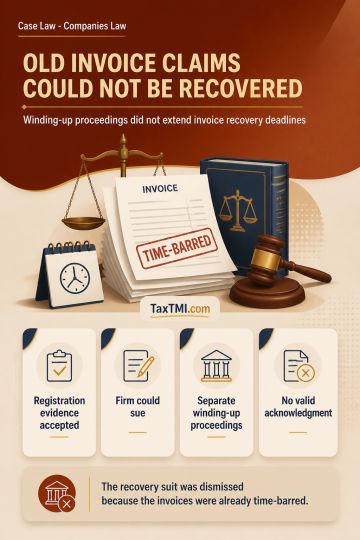
Invoice-based recovery claims remain time-barred despite separate winding-up proceedings, absent valid acknowledgment or part-payment of the disputed ...
Extended limitation fails without specific suppression allegations, while overseas employee secondment remains taxable as manpower supply within norma...
Time-share accommodation classification excludes Club or Association Service where purchasers receive contractual occupancy rights without genuine mem...
CENVAT credit for trading requires reversal, while taxable-service rental credit remains proportionately available and limitation issues await resolut...
Vicarious liability for dishonoured company cheques may extend to non-signatory directors where complaints contain foundational responsibility avermen...
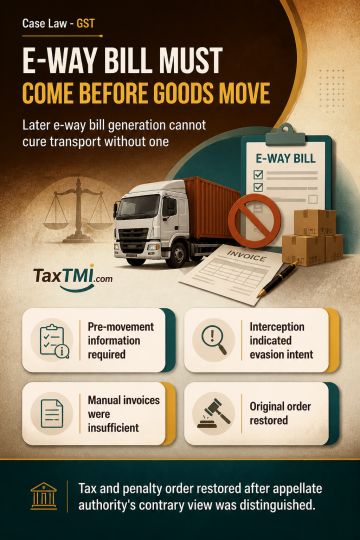
Rule 138(1) requires prescribed information to be furnished and an e-way bill generated before taxable goods begin moving. Transport without an e-way bill at interception was treated as establishing intent to evade tax, because later online generation could not cure the failure of statutory monitoring or prevent potential account manipulation. A manually issued invoice was not regarded as an equivalent safeguard. The appellate authority's contrary reliance on precedent was distinguished, and the original tax and penalty order under the detention provisions was restored.
Rule 138(1) requires prescribed information to be furnished and an e-way bill generated before taxable goods begin moving. Transport without an e-way bill at interception was treated as establishing intent to evade tax, because later online generation could not cure the failure of statutory monitoring or prevent potential account manipulation. A manually issued invoice was not regarded as an equivalent safeguard. The appellate authority's contrary reliance on precedent was distinguished, and the original tax and penalty order under the detention provisions was restored.
Note: It is a system-generated summary and is for quick reference only.
 TaxTMI
  TaxTMI
 of 4811











 Join Channel