Defined public benefit can retain charitable character; registration renewal requires examining genuine activities and legal compliance, not surplus a...
Capital reduction is distinct from share buy-back, preventing buy-back tax; restructuring interest and related business deductions also survive scruti...
Transfer pricing and tax deductions upheld on established principles, while employee contributions and warranty provisions returned for fresh examinat...
Captive transfer pricing relies on industrial consumer tariffs, while genuine quotations can benchmark effluent treatment transfers under the Other Me...
Specific tariff classification for ophthalmic instruments and extended limitation principles determine the treatment of duty demands, confiscation, an...
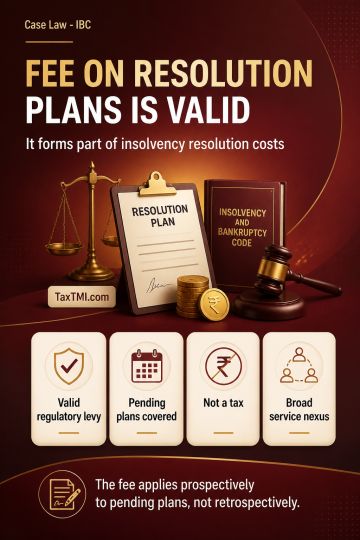
Regulation 31A authorises a regulatory fee on resolution plans as part of insolvency resolution process costs. The Insolvency and Bankruptcy Board's powers to levy fees and make regulations extend across the corporate insolvency resolution process and are not confined to service-provider registration or renewal. The residuary category of process costs may include the fee because the listed costs share no common genus limiting that power. The levy is a regulatory fee, not a tax: a broad nexus with regulatory services is sufficient and exact quid pro quo is unnecessary. It is neither arbitrary nor excessive merely because the regulator generates a surplus. The proviso applies prospectively to resolution plans pending adjudicatory approval and does not impose retrospective liability.
Regulation 31A authorises a regulatory fee on resolution plans as part of insolvency resolution process costs. The Insolvency and Bankruptcy Board's powers to levy fees and make regulations extend across the corporate insolvency resolution process and are not confined to service-provider registration or renewal. The residuary category of process costs may include the fee because the listed costs share no common genus limiting that power. The levy is a regulatory fee, not a tax: a broad nexus with regulatory services is sufficient and exact quid pro quo is unnecessary. It is neither arbitrary nor excessive merely because the regulator generates a surplus. The proviso applies prospectively to resolution plans pending adjudicatory approval and does not impose retrospective liability.
Note: It is a system-generated summary and is for quick reference only.
 TaxTMI
  TaxTMI
 of 4807





















 Join Channel