Business expenditure deduction requires proof of genuine commission payments and commercial allowability; turnover growth alone cannot validate the cl...
Article 8 treaty coverage excluded third-party airline support services, while documented demonetisation cash receipts remained accepted business inco...
Functional comparability under TNMM requires highway contract benchmarks to reflect operation, maintenance and transfer activities, requiring fresh be...
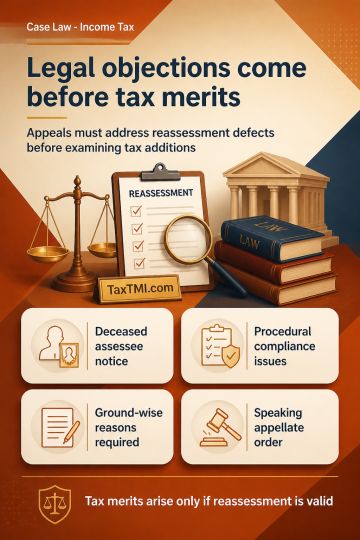
Jurisdictional objections in reassessment, including a notice issued in the name of a deceased assessee and alleged procedural non-compliance, must be addressed before merits where they could invalidate the reassessment. Section 250(6) requires the appellate authority to identify each point for determination, record its decision and provide reasons; a general reference to the assessment order does not constitute ground-wise reasoned adjudication. The authority's power to set aside a best-judgment assessment does not remove this obligation. Jurisdictional and legal grounds should be decided through a speaking order before additions are examined on merits, which arise only if the reassessment is valid.
Jurisdictional objections in reassessment, including a notice issued in the name of a deceased assessee and alleged procedural non-compliance, must be addressed before merits where they could invalidate the reassessment. Section 250(6) requires the appellate authority to identify each point for determination, record its decision and provide reasons; a general reference to the assessment order does not constitute ground-wise reasoned adjudication. The authority's power to set aside a best-judgment assessment does not remove this obligation. Jurisdictional and legal grounds should be decided through a speaking order before additions are examined on merits, which arise only if the reassessment is valid.
Note: It is a system-generated summary and is for quick reference only.
 TaxTMI
 of 4805


















 Join Channel


 TaxTMI