Input tax credit conditions remain constitutionally valid, with eligible recipient claims considered under GST circulars and retrospective filing dead...
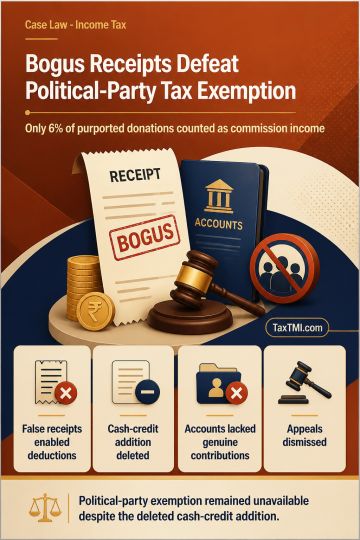
Bogus donation receipts justified commission income assessment and defeated political-party tax exemption for inaccurate accounts and reporting failur...
Pure reimbursement without income element escapes tax withholding, while delayed withholding and unsupported provisions face deferred or renewed scrut...
Public benefit requirement defeats charitable registration where residents' association services are reciprocal, member-only facilities governed by mu...
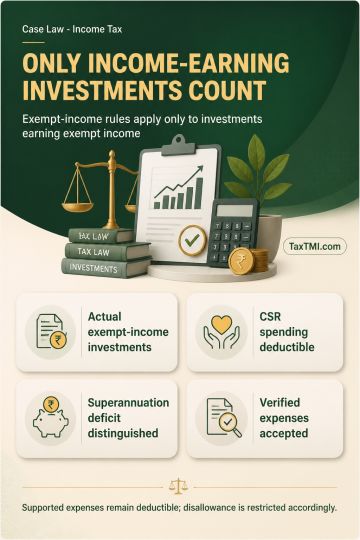
Exempt-income expenditure disallowance is confined to investments that actually generated exempt income, while supported business expenses remain dedu...
Registration of a partnership firm was proved by the Registrar...
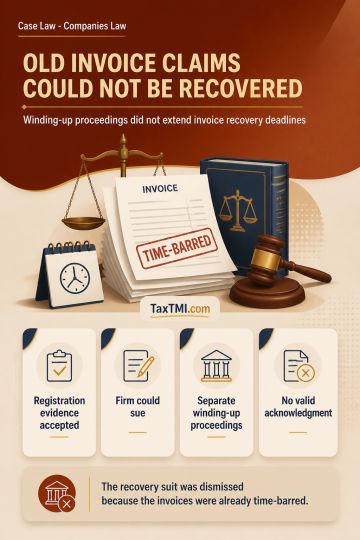
Invoice-based recovery claims remain time-barred despite separate winding-up proceedings, absent valid acknowledgment or part-payment of the disputed invoices.
Contents
Summary
Note
Bookmark
Share
✓ Copied successfully !
Print
Print Options
For full text, please login
Login to TaxTMI
Verification Pending
The Email Id has not been verified. Click on the link we have sent on
Registration of a partnership firm was proved by the Registrar of Firms' memorandum and a certified Form-VIII admitted as additional evidence because it enabled judgment and furthered justice. The firm was therefore competent to institute the suit. Limitation for invoice-based recovery was not extended or suspended by winding-up proceedings, which are independent of a civil money-recovery suit. The claim was based on individual invoices rather than a running account, and the relied-on communication neither acknowledged the disputed debt nor constituted part-payment for those invoices. As the relevant invoices were already time-barred, the recovery suit was dismissed.
Registration of a partnership firm was proved by the Registrar of Firms' memorandum and a certified Form-VIII admitted as additional evidence because it enabled judgment and furthered justice. The firm was therefore competent to institute the suit. Limitation for invoice-based recovery was not extended or suspended by winding-up proceedings, which are independent of a civil money-recovery suit. The claim was based on individual invoices rather than a running account, and the relied-on communication neither acknowledged the disputed debt nor constituted part-payment for those invoices. As the relevant invoices were already time-barred, the recovery suit was dismissed.
Note: It is a system-generated summary and is for quick reference only.
 TaxTMI
 of 4798









 Join Channel


 TaxTMI
