CENVAT credit for trading requires reversal, while taxable-service rental credit remains proportionately available and limitation issues await resolut...
Vicarious liability for dishonoured company cheques may extend to non-signatory directors where complaints contain foundational responsibility avermen...
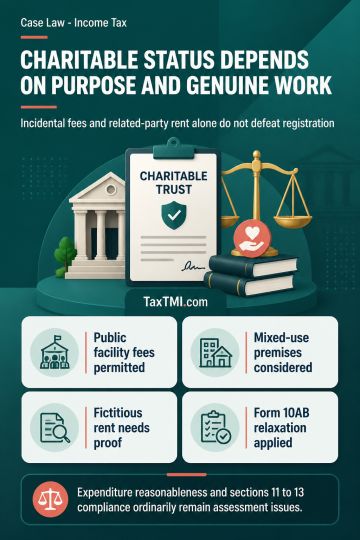
Charitable registration turns on predominant purpose and genuine activities, while incidental fees and related-party rent require supporting adverse m...
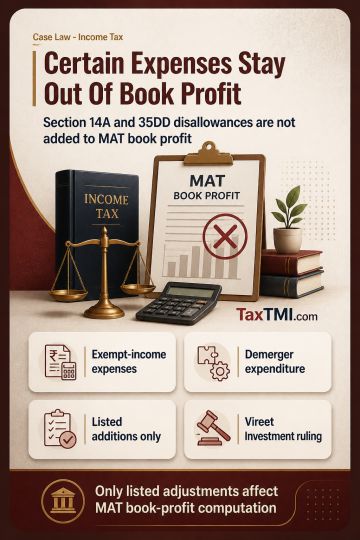
MAT book-profit adjustments exclude disallowances for exempt-income expenditure and demerger expenditure unless expressly listed under the statutory c...
Page of 4790
Press 'Enter' after typing page number.
41 to 60 of 95794 Results
❮
❯
❯❯
0 / 200
Expand Note
Add to Folder
No Folders have been created
+
Are you sure you want to delete "My most important" ?
Registration of a partnership firm was proved by the Registrar...
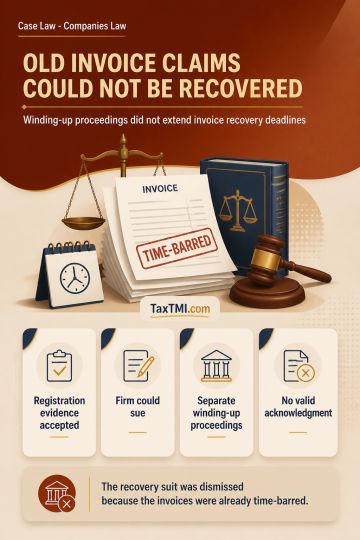
Invoice-based recovery claims remain time-barred despite separate winding-up proceedings, absent valid acknowledgment or part-payment of the disputed invoices.
Contents
Summary
Note
Bookmark
Share
✓ Copied successfully !
Print
Print Options
For full text, please login
Login to TaxTMI
Verification Pending
The Email Id has not been verified. Click on the link we have sent on
Registration of a partnership firm was proved by the Registrar of Firms' memorandum and a certified Form-VIII admitted as additional evidence because it enabled judgment and furthered justice. The firm was therefore competent to institute the suit. Limitation for invoice-based recovery was not extended or suspended by winding-up proceedings, which are independent of a civil money-recovery suit. The claim was based on individual invoices rather than a running account, and the relied-on communication neither acknowledged the disputed debt nor constituted part-payment for those invoices. As the relevant invoices were already time-barred, the recovery suit was dismissed.
Registration of a partnership firm was proved by the Registrar of Firms' memorandum and a certified Form-VIII admitted as additional evidence because it enabled judgment and furthered justice. The firm was therefore competent to institute the suit. Limitation for invoice-based recovery was not extended or suspended by winding-up proceedings, which are independent of a civil money-recovery suit. The claim was based on individual invoices rather than a running account, and the relied-on communication neither acknowledged the disputed debt nor constituted part-payment for those invoices. As the relevant invoices were already time-barred, the recovery suit was dismissed.
Note: It is a system-generated summary and is for quick reference only.
 TaxTMI
 of 4790




 Join Channel


 TaxTMI