Admissibility of electronic evidence bars undervaluation demands where printouts, retracted statements and no cross-examination leave the case unprove...
Limitation in oppression and mismanagement proceedings: prior knowledge of removal and dilution barred the challenge, with valuation directions upheld...
Insolvency professional agency governance rules amended to add nominee directors, tighten independent director eligibility, and regulate managing dire...
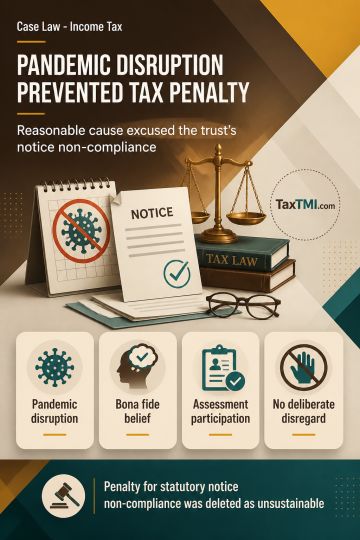
Pandemic-related disruption, a plausible bona fide belief about return-filing obligations, and subsequent participation in assessment proceedings are identified as reasonable cause for non-compliance with statutory notices by an educational trust. The note states that mere non-compliance, without independent material showing deliberate or wilful disregard, does not justify penalty. It further describes penalty provisions as quasi-criminal and inapplicable to technical or venial defaults where surrounding circumstances establish reasonable cause. On these grounds, the penalty for non-compliance with statutory notices was described as unsustainable and deleted.
Pandemic-related disruption, a plausible bona fide belief about return-filing obligations, and subsequent participation in assessment proceedings are identified as reasonable cause for non-compliance with statutory notices by an educational trust. The note states that mere non-compliance, without independent material showing deliberate or wilful disregard, does not justify penalty. It further describes penalty provisions as quasi-criminal and inapplicable to technical or venial defaults where surrounding circumstances establish reasonable cause. On these grounds, the penalty for non-compliance with statutory notices was described as unsustainable and deleted.
Note: It is a system-generated summary and is for quick reference only.
 TaxTMI
  TaxTMI
 of 4814


 Join Channel