Transfer pricing and tax deductions upheld on established principles, while employee contributions and warranty provisions returned for fresh examinat...
Captive transfer pricing relies on industrial consumer tariffs, while genuine quotations can benchmark effluent treatment transfers under the Other Me...
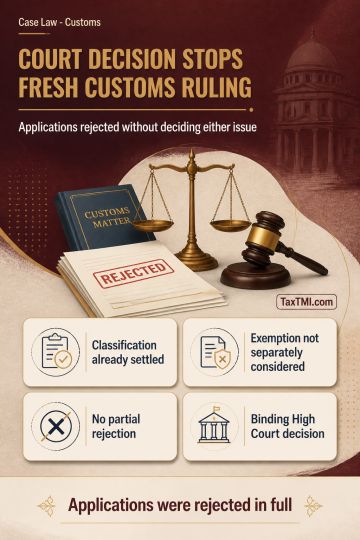
Specific tariff classification for ophthalmic instruments and extended limitation principles determine the treatment of duty demands, confiscation, an...
Integrated golf function determines classification, placing launch monitors and simulators under other golf equipment rather than measuring instrument...
Public servant status under anti-corruption law extends to recognised stock exchange leadership; constitutional and sanction challenges do not succeed...
Acquiescence, homebuyer protection and clean-slate resolution principles prevent landowners from disrupting an integrated project through late termina...
Page of 4817
Press 'Enter' after typing page number.
1501 to 1520 of 96333 Results
❮
❯
❯❯
0 / 200
Expand Note
Add to Folder
No Folders have been created
+
Are you sure you want to delete "My most important" ?
For dishonour of a cheque drawn on a company account, the company must be arraigned as an accused before vicarious liability can attach to an authorised signatory or other persons responsible for its business. Omission of the company is a foundational defect that prevents valid cognizance under the Negotiable Instruments Act. Section 319 CrPC cannot be used to cure that defect by subsequently impleading the company after the statutory limitation period; any fresh complaint remains subject to limitation and delayed cognizance requires sufficient cause. The Supreme Court quashed the complaint and consequential proceedings, and held that the direction to suo motu arraign the company exceeded jurisdiction.
For dishonour of a cheque drawn on a company account, the company must be arraigned as an accused before vicarious liability can attach to an authorised signatory or other persons responsible for its business. Omission of the company is a foundational defect that prevents valid cognizance under the Negotiable Instruments Act. Section 319 CrPC cannot be used to cure that defect by subsequently impleading the company after the statutory limitation period; any fresh complaint remains subject to limitation and delayed cognizance requires sufficient cause. The Supreme Court quashed the complaint and consequential proceedings, and held that the direction to suo motu arraign the company exceeded jurisdiction.
Note: It is a system-generated summary and is for quick reference only.
 TaxTMI
  TaxTMI
 of 4817




















 Join Channel