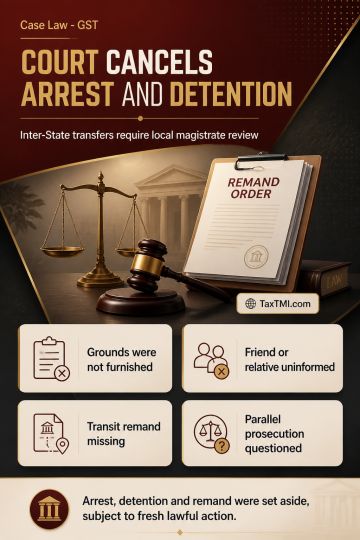
Arrest safeguards and transit remand requirements invalidated detention following inter-State transfer without communicated grounds or magistrate auth...
Arrest safeguards require disclosed grounds, relative intimation and transit remand, while duplicate prosecution under the CGST framework is unsustain...
Document Identification Number defects can invalidate GST assessments, with delayed challenges entertained conditionally where patent irregularities e...
Windmill commissioning evidence supported higher depreciation where grid connection and electricity generation proved operational use before the relev...
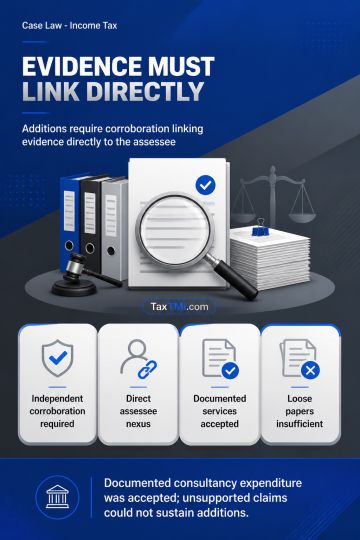
Pharmaceutical promotion and transfer-pricing comparability principles limited disallowances, while uncorroborated search allegations and unsupported ...
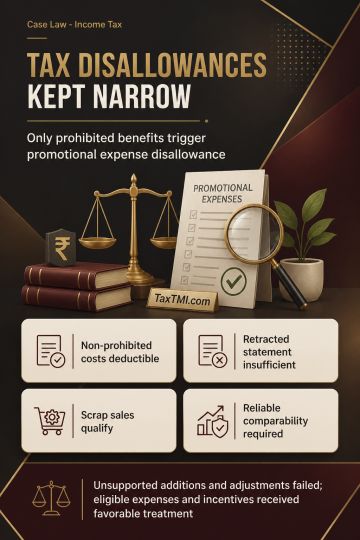
Business expenditure substantiation supports scrap credits, statutory payments and expense claims, while depreciation requires proof of actual busines...
Page of 4786
Press 'Enter' after typing page number.
461 to 480 of 95715 Results
❮
❯
❯❯
0 / 200
Expand Note
Add to Folder
No Folders have been created
+
Are you sure you want to delete "My most important" ?
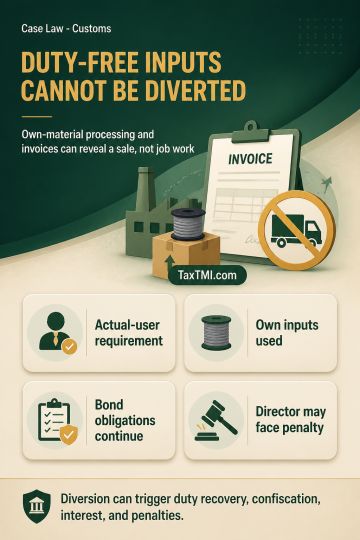
Duty-free imported inputs must be used by the actual user and cannot be sold or transferred contrary to exemption conditions. The notes explain that job work requires production substantially from materials supplied by the customer; where processors use their own inputs, issue sale invoices for different intermediate goods, and adjust the imported input's value against sale prices, the arrangement constitutes a sale rather than job work. Such diversion supports confiscation, recovery of duty with interest, and penalty. Obligations under import bonds continue until discharge, so the duty recovery is not time-barred; suppression of diversion by presenting sales as job work also warrants penalty. A director responsible for diversion may be penalised under section 112(a)(ii).
Duty-free imported inputs must be used by the actual user and cannot be sold or transferred contrary to exemption conditions. The notes explain that job work requires production substantially from materials supplied by the customer; where processors use their own inputs, issue sale invoices for different intermediate goods, and adjust the imported input's value against sale prices, the arrangement constitutes a sale rather than job work. Such diversion supports confiscation, recovery of duty with interest, and penalty. Obligations under import bonds continue until discharge, so the duty recovery is not time-barred; suppression of diversion by presenting sales as job work also warrants penalty. A director responsible for diversion may be penalised under section 112(a)(ii).
Note: It is a system-generated summary and is for quick reference only.
 TaxTMI
 of 4786











 Join Channel


 TaxTMI