Transfer pricing and tax deductions upheld on established principles, while employee contributions and warranty provisions returned for fresh examinat...
Captive transfer pricing relies on industrial consumer tariffs, while genuine quotations can benchmark effluent treatment transfers under the Other Me...
Specific tariff classification for ophthalmic instruments and extended limitation principles determine the treatment of duty demands, confiscation, an...
Integrated golf function determines classification, placing launch monitors and simulators under other golf equipment rather than measuring instrument...
Public servant status under anti-corruption law extends to recognised stock exchange leadership; constitutional and sanction challenges do not succeed...
Acquiescence, homebuyer protection and clean-slate resolution principles prevent landowners from disrupting an integrated project through late termina...
Page of 4792
Press 'Enter' after typing page number.
1001 to 1020 of 95833 Results
❮
❯
❯❯
0 / 200
Expand Note
Add to Folder
No Folders have been created
+
Are you sure you want to delete "My most important" ?
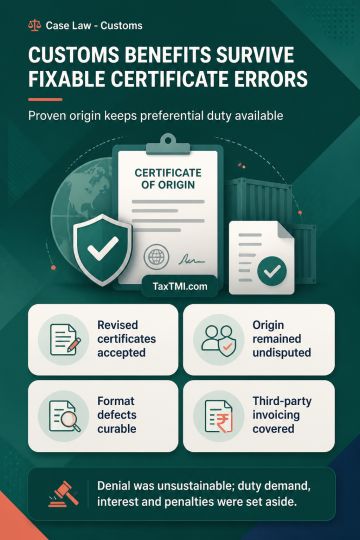
Preferential customs duty benefit may remain available where revised or rectified Certificates of Origin are submitted within the prescribed period and the goods' origin and certificate authenticity are undisputed. The discussion states that origin rules permit replacement of erroneous certificates and retrospective issuance, and that procedural discrepancies should be read harmoniously with domestic verification requirements rather than extinguish substantive treaty benefits. It also notes that subsequent submission of a valid certificate can cure format-related defects, including under third-party invoicing arrangements, without altering origin, value or goods description. On the stated facts, denial of concessional duty was treated as unsustainable and the related duty demand, interest and penalties were set aside.
Preferential customs duty benefit may remain available where revised or rectified Certificates of Origin are submitted within the prescribed period and the goods' origin and certificate authenticity are undisputed. The discussion states that origin rules permit replacement of erroneous certificates and retrospective issuance, and that procedural discrepancies should be read harmoniously with domestic verification requirements rather than extinguish substantive treaty benefits. It also notes that subsequent submission of a valid certificate can cure format-related defects, including under third-party invoicing arrangements, without altering origin, value or goods description. On the stated facts, denial of concessional duty was treated as unsustainable and the related duty demand, interest and penalties were set aside.
Note: It is a system-generated summary and is for quick reference only.
 TaxTMI
 of 4792






















 Join Channel


 TaxTMI