Admissibility of electronic evidence bars undervaluation demands where printouts, retracted statements and no cross-examination leave the case unprove...
Limitation in oppression and mismanagement proceedings: prior knowledge of removal and dilution barred the challenge, with valuation directions upheld...
Insolvency professional agency governance rules amended to add nominee directors, tighten independent director eligibility, and regulate managing dire...
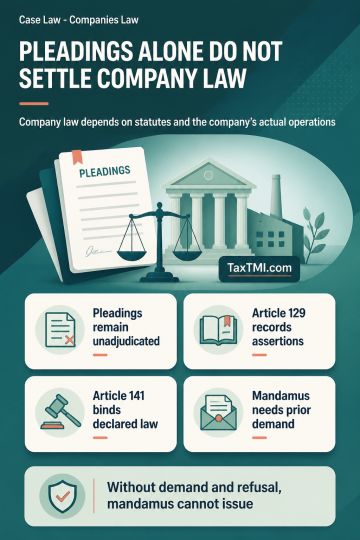
Unadjudicated assertions in pleadings filed before the Supreme Court do not establish the legal correctness of those assertions or bind other courts on the statute governing a company. The Court-of-Record status under Article 129 confirms the record of what was asserted, while binding force under Article 141 arises only from law declared by the Supreme Court. The applicable company-law regime must be determined from the statutory framework and the company's objects, activities and operational circumstances. The notes also explain that mandamus ordinarily requires a prior distinct demand to the statutory authority and its refusal or neglect; without those prerequisites, mandamus cannot issue.
Unadjudicated assertions in pleadings filed before the Supreme Court do not establish the legal correctness of those assertions or bind other courts on the statute governing a company. The Court-of-Record status under Article 129 confirms the record of what was asserted, while binding force under Article 141 arises only from law declared by the Supreme Court. The applicable company-law regime must be determined from the statutory framework and the company's objects, activities and operational circumstances. The notes also explain that mandamus ordinarily requires a prior distinct demand to the statutory authority and its refusal or neglect; without those prerequisites, mandamus cannot issue.
Note: It is a system-generated summary and is for quick reference only.
 TaxTMI
  TaxTMI
 of 4814


 Join Channel