Admissibility of electronic evidence bars undervaluation demands where printouts, retracted statements and no cross-examination leave the case unprove...
Page of 4809
Press 'Enter' after typing page number.
3221 to 3240 of 96177 Results
❮
❯
❯❯
0 / 200
Expand Note
Add to Folder
No Folders have been created
+
Are you sure you want to delete "My most important" ?
Modification of bail conditions is not barred by Section 362...
Modification of bail conditions remains available through inherent jurisdiction where onerous deposits undermine justice and cannot recover disputed dues.
Contents
Summary
Note
Bookmark
Share
✓ Copied successfully !
Print
Print Options
For full text, please login
Login to TaxTMI
Verification Pending
The Email Id has not been verified. Click on the link we have sent on
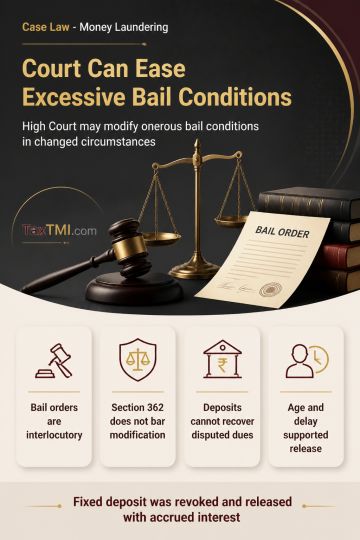
Modification of bail conditions is not barred by Section 362 Cr.P.C. because a bail order is interlocutory and does not finally dispose of the criminal case. The notes state that a High Court may use inherent jurisdiction to vary such conditions where changed circumstances require intervention to secure the ends of justice. They further explain that bail conditions cannot operate as a mechanism to recover disputed dues before trial: a monetary deposit imposed without prima facie satisfaction of guilt may be unreasonably onerous. In the circumstances described, closure of proceedings against co-accused, absence of an early trial, and the applicant's age supported revocation of the fixed-deposit condition and release of the deposit with accrued interest.
Modification of bail conditions is not barred by Section 362 Cr.P.C. because a bail order is interlocutory and does not finally dispose of the criminal case. The notes state that a High Court may use inherent jurisdiction to vary such conditions where changed circumstances require intervention to secure the ends of justice. They further explain that bail conditions cannot operate as a mechanism to recover disputed dues before trial: a monetary deposit imposed without prima facie satisfaction of guilt may be unreasonably onerous. In the circumstances described, closure of proceedings against co-accused, absence of an early trial, and the applicant's age supported revocation of the fixed-deposit condition and release of the deposit with accrued interest.
Note: It is a system-generated summary and is for quick reference only.
 TaxTMI
  TaxTMI
 of 4809


 Join Channel