Prolonged sterilisation of development rights supports capital-gains treatment, while business-income disallowances cannot govern capital-gains comput...
Additional evidence in transfer pricing dispute leads to fresh examination, while tax deductions, TDS credit, fee and refund interest require verifica...
Category II AIF pass-through taxation preserves non-business income character; investment receipts cannot be reclassified without applying recognised ...
Mutual fund maturity rules require proper rollover, redemption, disclosure, and due diligence; investor gains cannot excuse regulatory breaches or pen...
Threshold exemption excludes exempt services, while stamp-paper purchases avoid reverse charge; consequential service tax penalties were also set asid...
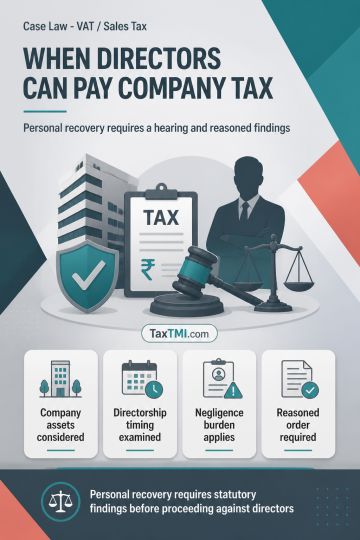
Section 39 permits personal recovery of a company's tax dues from a Director only after considering the availability of company assets, whether the person was a Director when the dues arose, and whether non-recovery resulted from negligence, misfeasance or breach of duty. The Director bears the statutory burden of establishing that non-recovery was not attributable to such conduct. Recovery from personal assets requires a hearing and a reasoned order on these matters, while recovery may first be pursued against company assets and subsequently against Directors under the statutory scheme.
Section 39 permits personal recovery of a company's tax dues from a Director only after considering the availability of company assets, whether the person was a Director when the dues arose, and whether non-recovery resulted from negligence, misfeasance or breach of duty. The Director bears the statutory burden of establishing that non-recovery was not attributable to such conduct. Recovery from personal assets requires a hearing and a reasoned order on these matters, while recovery may first be pursued against company assets and subsequently against Directors under the statutory scheme.
Note: It is a system-generated summary and is for quick reference only.
 TaxTMI
 of 4792






















 Join Channel


 TaxTMI
