Development agreements require legal possession or effective enjoyment for capital gains transfer; permissive possession and deferred consideration de...
Prolonged sterilisation of development rights supports capital-gains treatment, while business-income disallowances cannot govern capital-gains comput...
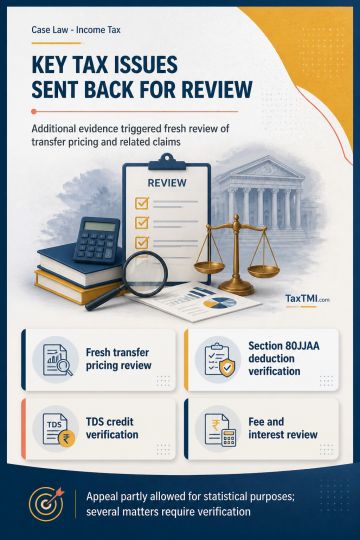
Additional evidence in transfer pricing dispute leads to fresh examination, while tax deductions, TDS credit, fee and refund interest require verifica...
Category II AIF pass-through taxation preserves non-business income character; investment receipts cannot be reclassified without applying recognised ...
Mutual fund maturity rules require proper rollover, redemption, disclosure, and due diligence; investor gains cannot excuse regulatory breaches or pen...
Threshold exemption excludes exempt services, while stamp-paper purchases avoid reverse charge; consequential service tax penalties were also set asid...
Page of 4786
Press 'Enter' after typing page number.
921 to 940 of 95714 Results
❮
❯
❯❯
0 / 200
Expand Note
Add to Folder
No Folders have been created
+
Are you sure you want to delete "My most important" ?
For penalty proceedings under section 270A, a show cause notice alleging misreporting must disclose the specific factual basis and category of misreporting so the taxpayer can respond meaningfully. Misreporting is treated as under-reporting involving bad faith, attracts a higher penalty, and precludes immunity; therefore, a bare allegation is insufficient. The notes state that notices and the penalty order merely asserted misreporting without particulars or reasons, and that the tax sought to be evaded required reconsideration. The High Court set aside the penalty order as unsustainable, while permitting fresh proceedings in accordance with law and leaving all contentions open.
For penalty proceedings under section 270A, a show cause notice alleging misreporting must disclose the specific factual basis and category of misreporting so the taxpayer can respond meaningfully. Misreporting is treated as under-reporting involving bad faith, attracts a higher penalty, and precludes immunity; therefore, a bare allegation is insufficient. The notes state that notices and the penalty order merely asserted misreporting without particulars or reasons, and that the tax sought to be evaded required reconsideration. The High Court set aside the penalty order as unsustainable, while permitting fresh proceedings in accordance with law and leaving all contentions open.
Note: It is a system-generated summary and is for quick reference only.
 TaxTMI
 of 4786
















 Join Channel



 TaxTMI