Capital reduction is distinct from share buy-back, preventing buy-back tax; restructuring interest and related business deductions also survive scruti...
Transfer pricing and tax deductions upheld on established principles, while employee contributions and warranty provisions returned for fresh examinat...
Captive transfer pricing relies on industrial consumer tariffs, while genuine quotations can benchmark effluent treatment transfers under the Other Me...
Specific tariff classification for ophthalmic instruments and extended limitation principles determine the treatment of duty demands, confiscation, an...
Integrated golf function determines classification, placing launch monitors and simulators under other golf equipment rather than measuring instrument...
Public servant status under anti-corruption law extends to recognised stock exchange leadership; constitutional and sanction challenges do not succeed...
Page of 4786
Press 'Enter' after typing page number.
881 to 900 of 95714 Results
❮
❯
❯❯
0 / 200
Expand Note
Add to Folder
No Folders have been created
+
Are you sure you want to delete "My most important" ?
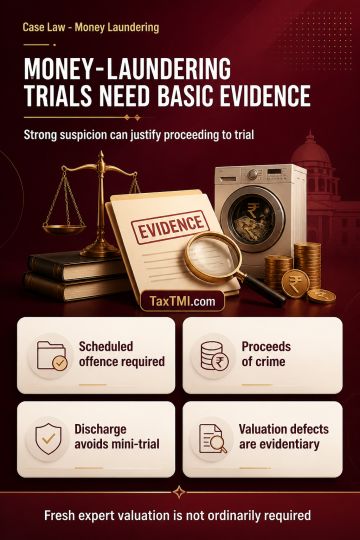
Money-laundering prosecution is described as requiring a scheduled offence, proceeds of crime generated from that offence, and their projection as untainted, including knowing assistance in related processes. Challenges to investigation or discharge grounds in predicate offences are presented as outside the scope of the money-laundering proceeding. The notes explain that discharge requires assessment of a prima facie case and that strong suspicion may justify trial without a mini-trial. They also state that alleged defects in an authorised valuation report are evidentiary matters, and fresh expert valuation is not ordinarily required; loss quantification mainly concerns the predicate offence.
Money-laundering prosecution is described as requiring a scheduled offence, proceeds of crime generated from that offence, and their projection as untainted, including knowing assistance in related processes. Challenges to investigation or discharge grounds in predicate offences are presented as outside the scope of the money-laundering proceeding. The notes explain that discharge requires assessment of a prima facie case and that strong suspicion may justify trial without a mini-trial. They also state that alleged defects in an authorised valuation report are evidentiary matters, and fresh expert valuation is not ordinarily required; loss quantification mainly concerns the predicate offence.
Note: It is a system-generated summary and is for quick reference only.
 TaxTMI
 of 4786



















 Join Channel


 TaxTMI